Media Coursework Evaluation
my media coursework evaluation which includes a description of the production process of our products

Media Coursework Evaluation
E N D
Presentation Transcript
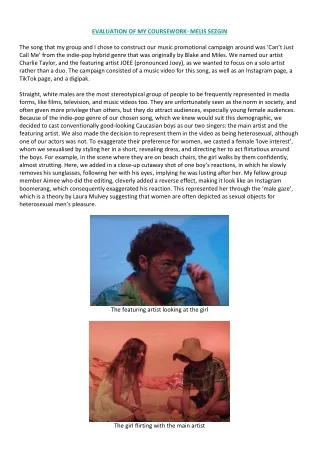
EVALUATION OF MY COURSEWORK- MELIS SEZGIN The song that my group and I chose to construct our music promotional campaign around was ‘Can’t Just Call Me’ from the indie-pop hybrid genre that was originally by Blake and Miles. We named our artist Charlie Taylor, and the featuring artist JOEE (pronounced Joey), as we wanted to focus on a solo artist rather than a duo. The campaign consisted of a music video for this song, as well as an Instagram page, a TikTok page, and a digipak. Straight, white males are the most stereotypical group of people to be frequently represented in media forms, like films, television, and music videos too. They are unfortunately seen as the norm in society, and often given more privilege than others, but they do attract audiences, especially young female audiences. Because of the indie-pop genre of our chosen song, which we knew would suit this demographic, we decided to cast conventionally good-looking Caucasian boys as our two singers: the main artist and the featuring artist. We also made the decision to represent them in the video as being heterosexual, although one of our actors was not. To exaggerate their preference for women, we casted a female ‘love interest’, whom we sexualised by styling her in a short, revealing dress, and directing her to act flirtatious around the boys. For example, in the scene where they are on beach chairs, the girl walks by them confidently, almost strutting. Here, we added in a close-up cutaway shot of one boy’s reactions, in which he slowly removes his sunglasses, following her with his eyes, implying he was lusting after her. My fellow group member Aimee who did the editing, cleverly added a reverse effect, making it look like an Instagram boomerang, which consequently exaggerated his reaction. This represented her through the ‘male gaze’, which is a theory by Laura Mulvey suggesting that women are often depicted as sexual objects for heterosexual men’s pleasure. The featuring artist looking at the girl The girl flirting with the main artist
The song which we chose for our music video was part of the indie-pop genre, and had a very fun, summery feel to it. Our peers and advisors described it as having a ‘Los Angeles vibe’, so we based our artist’s branding around this. We decided to use vibrant colours, particularly blues, pinks, and yellows in all our products, as well as always trying to maintain a beachy atmosphere, which was very helpful in terms of building a star persona for our artist. It meant they would stand out from others and were recognisable just from their colour scheme. In addition, the liveliness of the products linked back to the genre, where these kinds of vivid images are common, and loved by fans. Our photoshoots for the social media had prominent blue and pink lighting, as well as beach themed props, tying into our music video and digipak. In a few photos which we ended up posting on Instagram, we used the same giant beach ball that appears in the video. The digipak also illustrated a beach setting through a digital drawing. We did consider having the artist himself on the digipak, but we noticed that similar artists from the indie genre such as ‘Surfaces’ and ‘Tame Impala’ were using graphic design on their album covers, and it was still cohesive with their brand. The drawing on the front cover was very simple, almost childish, which helped us to further capture the young, energetic character of the artist. Also, the track list on the back cover included many song titles that nodded to the Californian seaside aspect of the brand. To add onto the fun element of the artist’s personality, we added in some subtly funny captions under our Instagram posts, for example “Bestie vibes only” under a post of him and the featuring artist from a photoshoot, which is a modern, jokey phrase used mostly by Gen Z on the social media app TikTok, therefore also portraying the artist as trendy and youthful. One of the original digipak designs; blue, yellow, and pink umbrella. In the final design, the umbrella was rainbow coloured. Our primary method of interacting with potential audiences was through the entertainment aspect of the video. The props we used were not only beach themed, but also very childlike, such as the pool floats, or the buckets and spades. By doing this, we offered our viewers a window back into their childhood, creating a feeling of nostalgia. Blumler & Klatz’s theory about ‘diversion’ could be applied to our tactics, which suggests that all audiences are drawn to the ‘escape’ portion of media texts because it means they can temporarily get away from their boring everyday lives; they can become distracted from reality. However, the theorists also imply that audiences enjoy things they can relate to, and we made sure to do this through the low-budget aspect of our products. Our props, set and costumes were not particularly glamorous or expensive looking, which meant that we could appeal to a younger, as well as a slightly lower-class demographic. It could be interpreted that through our music video, we were hinting that anyone with talent can become successful, despite their financial situation.
In our social media posts, I feel that we should have included more parasocial interaction with our followers so that we could have grown it into a bigger, active fanbase. Clay Shirky’s ‘end of audience’ theory suggests that audiences no longer want to just observe media- the internet has changed them to want involvement as well. We could have done this through posts such as tour dates or merchandise, which may have prompted them to become more involved. Although, we did have a few other instances of interaction, including an Instagram story poll asking followers if it was too early to start celebrating Christmas, a caption reading “Guess who?” to motivate followers to comment with their best guesses as to who was hiding behind the beach ball in the photo, and finally, the bio of the Instagram profile which stated “CAN’T JUST CALL ME VIDEO OUT SOON!”, urging them to build excitement for the video release. In the process of planning our video, we had originally decided to stick with pop and indie-pop conventions. But while we did end up using them a lot in our final products, like the bright colour scheme and the conventionally attractive artists, there was a specific element of the video that went completely against music video conventions. Most videos are immersive into a different world, they encourage a suspension of disbelief; ours on the other hand, had a post-modern, self-aware aspect to it. Because the song was rather summery and American, and we were living in the rainy United Kingdom, we had the idea to create a purposely fake-looking indoor beach. We wanted to make it funny by having it look low-budget, and obvious that it was shot on a set rather than a real beach, which is rather unusual for a pop video- or any genre video for that matter. There were only a couple of examples we could find of this in popular videos, one of them being ‘I Don’t Care’ by Ed Sheeran and Justin Bieber, and the other being ‘Kiss You’ by One Direction. Both music videos went against conventions by openly displaying the green screens or studios they were in; the One Direction video even had the behind-the-scenes workers in shot. We replicated this on our shoot day in multiple ways, for instance in one of our set-ups, where you could see the edges of the set, where the coloured backdrop ended. We also selected two people to be the ‘crew members’ of this fake set, dressed in black with fake moustaches, and we had them appear in the video on
multiple occasions, for example when they brought on a beach sign prop halfway through a take, making them seem unprofessional, therefore further adding a comedic effect to the video. The fake crew members bringing on the sign As a whole, I feel that our music promotion campaign was successful, especially in terms of creating a consistent brand for our artist that fit into the genre’s conventions. I think that our sustained presentation of the beach theme and bright summer colours in all our products resulted in a harmonious star image overall, presenting Charlie Taylor as a fun and relatable person. However, I also believe that we could have done more to engage with our active audiences, so, in future projects I would plan on more frequently posting interactively on social media platforms.