Understanding the U.S. Government’s Global Health Architecture and Initiatives
40 likes | 175 Vues
This document provides an overview of the U.S. Government’s Global Health Initiative (GHI) and its various components, including the roles of key agencies such as the White House, Congress, and health organizations like HHS, CDC, and USAID. It highlights funding allocations, major global health programs like PEPFAR and PMI, and the collaborative efforts of multiple departments to tackle health challenges globally. The document also discusses U.S. contributions to organizations like the WHO and the importance of addressing global health issues through coordinated policies and funding strategies.


Understanding the U.S. Government’s Global Health Architecture and Initiatives
E N D
Presentation Transcript
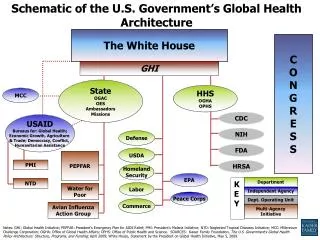
Schematic of the U.S. Government’s Global Health Architecture The White House C O N G R E S S GHI State OGAC OES Ambassadors Missions HHS OGHA OPHS MCC CDC USAID Bureaus for: Global Health; Economic Growth, Agriculture & Trade; Democracy, Conflict, Humanitarian Assistance NIH Defense FDA USDA PEPFAR PMI HRSA Homeland Security EPA K E Y Department NTD Labor Water for Poor Independent Agency Peace Corps Dept. Operating Unit Commerce Avian Influenza Action Group Multi-Agency Initiative Notes: GHI: Global Health Initiative; PEPFAR: President’s Emergency Plan for AIDS Relief; PMI: President’s Malaria Initiative; NTD: Neglected Tropical Diseases Initiative; MCC: Millennium Challenge Corporation; OGHA: Office of Global Health Affairs; OPHS: Office of Public Health and Science. SOURCES: Kaiser Family Foundation, The U.S. Government’s Global Health Policy Architecture: Structure, Programs, and Funding; April 2009; White House, Statement by the President on Global Health Initiative, May 5, 2009.
U.S. Global Health Initiative (GHI), Funding by Sector, FY 2009-FY 2011* In Millions $9.6b $8.8b $8.4b $155 $65 $25 $200 $75 $55 *FY 2011 is President’s Budget Request to Congress. Source: Kaiser Family Foundation analysis of data from the Office of Management and Budget, Agency Congressional Budget Justifications, Congressional Appropriations Bills, and White House Statement by the President on Global Health Initiative, May 5, 2009. Also see: Kates J., The U.S. Global Health Initiative: Overview & Budget Analysis, Menlo Park: Kaiser Family Foundation, December 2009.
Major U.S. Government Global Health Programs and Related Initiatives, 2010 1 or 2 Programs 3 or 4 Programs 5 or 6 Programs 7, 8, or 9 Programs Note: Programs include PEPFAR, TB, PMI, NTDs, MCH, FP, Polio, Water/Sanitation, Nutrition, and MCC. Source: Kaiser Family Foundation analysis of data from the Department of State FY2011 Foreign Operations Congressional Budget Justification, U.S. Agency and Program documents.
Distribution of Bilateral & Multilateral Funding in the U.S. Global Health Initiative (GHI), FY 2009 – FY 2011* *FY 2011 is President’s Budget Request to Congress. Note: Multilateral funding includes the Global Fund, GAVI, IAVI, UNAIDS, Global TB Drug Facility, and Microbicides. Other U.S. contributions to multilateral organizations, such as the WHO, are not currently counted as part of the GHI. Source: Kaiser Family Foundation analysis of data from the Office of Management and Budget, Agency Congressional Budget Justifications, Congressional Appropriations Bills, and White House Statement by the President on Global Health Initiative, May 5, 2009. Also see: Kates J., The U.S. Global Health Initiative: Overview & Budget Analysis, Menlo Park: Kaiser Family Foundation, December 2009.