Summary
270 likes | 392 Vues
This study assesses the effectiveness of EV-DO (Evolution Data-Optimized) technology as an alternative return channel for digital television broadcasting. It addresses key performance metrics such as throughput, delay, user population, and fairness. Through detailed modeling and simulation using the Tangram-II tool, we establish a comprehensive traffic model that accounts for the characteristics of dense urban environments. Our experiments reveal the implications of user population on throughput and delay, underscoring the critical need for fairness in resource allocation.


Summary
E N D
Presentation Transcript
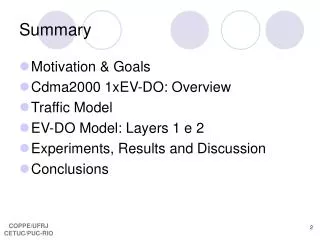
Summary • Motivation & Goals • Cdma2000 1xEV-DO: Overview • Traffic Model • EV-DO Model: Layers 1 e 2 • Experiments, Results and Discussion • Conclusions
Motivation & Goals • Evaluate EV-DO rev.0 as a alternative for the return channel of the Digital TV: • Throughput • Delay • User population • Fairness • Could we do better?
Pilot DRC ACK RRI Phase reference for demod.; Channel timing Forward channel data packets acknowledgment Reverse Rate Indicator Forward link rate sent to the BS Cdma2000 1xEV-DO: Overview • Reverse Link • Rates from 9.6 to 153.6Kbps per user • BPSK modulation • 53.30ms packets • Besides the data channel • Control Channel CDMA Power controlled: - open loop - closed loop
1.67ms TDM slots Always at max. power Cdma2000 1xEV-DO: Overview • Forward Link • Rates from 38.4kbps to 2.4Mbps through adaptive coding/modulation • Depends on the state of the forward link • Higher bit rates: lower robustness to channel impairments • PFS recommended for slot allocation • Main goal: throughput
1.67ms TDM slots Always at max. power Pilot RPC RA Bit open loop power control closed-loop power control congestion control Cdma2000 1xEV-DO: Overview • Forward Link (more...) • Four Packet Interlacing • Avoids temporary monopolization of slots • Early Termination • Gradual redundancy • Besides the data channel • Control Channel
Tangram-II Simulation Model Overview • Simulation Tool: • Tangram-II (Federal University of Rio de Janeiro – Brazil) • Why Tangram-II instead of NS? • Modeling is done through a high level interface: simplicity • Includes additional high-level constructs to facilitate the modeling task COPPE/UFRJ CETUC/PUC-RIO
Proposed model • Detailed (Physical and Link layers) EV-DO model • Related work typically: • Physical layer modeling • Lack of detailed traffic model • Few works modeling higher layers: • No open-source model presenting system capacity results as a function of user population • No detailed fairness analysis • Almost no clues on what could be done about fairness
Traffic Model • Assumptions • There is no users entering or leaving the system • No mobility – predominant scenario in the BDTvS
Traffic Model (more...) • Web users, on-off source COPPE/UFRJ CETUC/PUC-RIO
EV-DO Model • Assumptions: • A single EV-DO cell, no setorization: • Thus, no soft-handoff • Early Termination not implemented • Static users: low channel diversity
EV-DO Model: Physical layer • Propagation • Total power loss Ltotal[dB] propagation penetration penetration loss (10dB) Propagation loss shadowing fading (log-normal dist. de mean=0 and σ =8dB dense urban scenario)
EV-DO Model: Physical layer • Propagation (more...) • Okumura-Hata’s Propagation model for dense urban scenario BS antenna height (40m) dense urban correction factor : Carrier frequency (450MHz) AT height (1.5m)
EV-DO Model: Physical layer • Power Control: • Open Loop • Step 1: Pilot channel sensing • Step 2: Choose the lowest power such that: • After power losses it still reaches the receiver with enough strength to achieve the desired PER (1%)
EV-DO Model: Physical layer • Power Control (more…): • Closed loop • Step 1: BS calculates for each user • Step 2: • Matches the received power with d • Commands the AT to increase or decrease its power pilot channel received energy channel bandwidth (1.25MHz) thermal noise total perceived interfering power
EV-DO Model: Physical layer • DRC Estimation: Geometric Method • Step 1: Measure the received power from the BS: X • Step 2: Calculate SINR: Relation between X and the interference from rings 1 and 2 First interfering ring Second interfering ring
EV-DO Model: Physical layer • DRC Estimation : • Step 3: Find the higher DRC that matches the calculated SINR value, send it to the BS DRC Rate (kbps) SINR (dB) PER = 1%
EV-DO Model: Link layer • Scheduling Algorithm – PFS • Choose user j • Updating average rate for user i Last DRC value Received from user i User i average transmission rate User i current transmission rate PFS “fairness” parameter
EV-DO Model: Link layer • Congestion Control • Noise rise – δR • δR =Nt/N0 • δR = 5 as a threshold for the RA bit activation • If the base station activates the RA Bit, ATs decreases its reverse date rate transmissions thermal noise power total interfering power
Experiments: Considerations • Dense urban scenario • Web user population: from 10 to 80 • Interest Metrics: • Throughput; Delay; Fairness
Results: User Throughput vs. Pop. and zone • Decreasing Throughput with increasing population and distance Throughput (Kbps) Population Zone
Results: User Delay vs. Pop. and zone • Increasing delay with increasing population and distance Delay (s) Zone Population
alpha = 1.0 alpha = 0.001 Round Robin PFS throughput (Kbps) Zone Results: User Throughput vs. PFS α • PFS α - Extreme values: no significant fairness variation • α = 1 – Round Robin • α = 0.001 – PFS: Strong Throughput priority
Discussion: Fairness issue • Throughput, delay quite worse for the most distant users • PFS α parameter adjustment • Same fairness issue • Worst overall throughput
1-zone 2-zones 1-user Proposed Solution: Directional Antenas • Former experiments: • Experiment 1: • Experiment 2: • Experiment 3: no-users (no directional antennas) … … … … … … … … … … 1 8 9 10 2 3 Distance Zone
Results: User Thoughput - fairness through directional antennas • Population of 60 users No user 1-user 1-zone 2-zones throughput (Kbps) Zone • From white to black bars: Increasing Fairness (thoughput)
Results: User Delay - fairness through directional antennas • Population of 60 users No user 1-user 1-zone 2-zones Delay (s) Zone • From white to black bars: Increasing Fairness (delay)
Results: User throughput - directional antennas for two zones 60 users 80 users throughput (Kbps) Zone directional antennas • Increased population: No significant fairness difference • The are no direction antennas in zones 1 to 8