Download
1 / 21
210 likes | 345 Vues
This homework review covers essential concepts in ecology and environmental science. It addresses the roles of producers in food webs, the process of half-lives using uranium-235 as an example, and explanations of water-related terms such as aquifers, drainage basins, and watersheds. Additionally, it discusses the differences between permeable and impermeable substances, as well as eutrophication and the characteristics of estuaries. This overview serves as a guide for students to grasp fundamental ecological concepts crucial for understanding ecosystems.

E N D
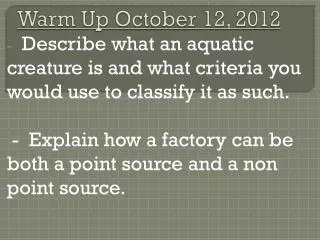
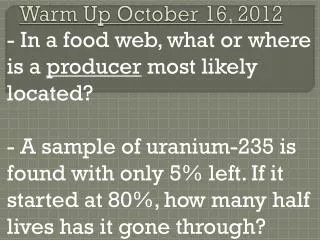
Warm Up October 16, 2012 - In a food web, what or where is a producer most likely located? - A sample of uranium-235 is found with only 5% left. If it started at 80%, how many half lives has it gone through?
Permeable vs Impermeable Permeable is a substance that liquids can flow through. Impermeable is a substance that liquids cannot flow through.
Aquifer - An underground layer of permeable rock or sediment that contains water.
Groundwater Water that is held underground.
Divide A ridge, or continuous line of high land
Drainage Basin An area of land in which water drains into a stream system
Water Table The top region of an area that is saturated with water
Eutrophication An increase in the nutrients in a lake or pond.
Iceberg Mass of floating ice floating on the ocean
Watershed A watershed is the area of land where all of the water that is under it or drains off of it goes into the same place
Watershed Give me that homework.
Solvent Solute A substance that does the dissolving. A substance that is dissolved.
Solubility The ability of a substance to be dissolved.
Estuary A shoreline area where fresh water from a river mixes with salt water from the ocean
Fresh water rivers run into salty coastal waters. Two big groups of life breed & feed in the tall grasses of our estuaries.
2 types of estuaries: Salt marsh Mangrove forest