Download
1 / 7
70 likes | 189 Vues
This guide explores the construction and properties of rotation matrices, emphasizing their relationship with eigenvectors and eigenvalues. It covers how to rotate vectors in a 2D plane, the significance of the rotation matrix in geometric transformations, and how eigenvalues can be complex in certain scenarios. The discussion includes practical examples, particularly dealing with coefficients for varying angles relative to the x-axis, and highlights the limitations of plotting complex eigenvectors on the XY-plane.

E N D
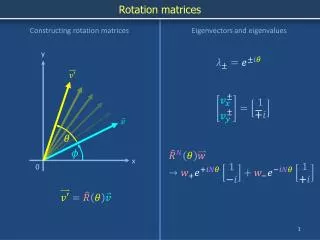
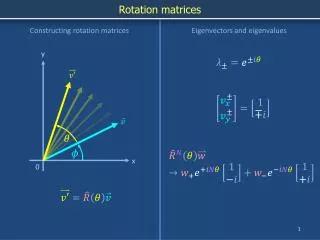
Rotation matrices Constructing rotation matrices Eigenvectors and eigenvalues y x 0
Rotating a vector y Length v x 0
Repeatedly rotating a vector y x 0 How can we recognize a rotation matrix? STOP
Rotation matrices Constructing rotation matrices Eigenvectors and eigenvalues y x 0
Complex eigenvalues and eigenvectors Please confirm these last 2 lines Complex eigenvalues Complex eigenvectors STOP
Complex eigenvalues and eigenvectors Complex eigenvalues Complex eigenvectors
Complex eigenvalues and eigenvectors y Consider an example with w+ = w- = w/2 x 0 In this example, the initial vector points directly to the right. How should the coefficients w+ and w- be changed to represent an initial vector pointing at an arbitrary initial anglerelative to the x axis? Can you plot the eigenvectors (1, ±i) on the xy plane? (No). Why not?

![[MATRICES ]](https://cdn4.slideserve.com/144276/matrices-dt.jpg)