Understanding Differential Equations - Population Growth Models
Explore the general solutions to DEs, logistic growth models, and applications in population growth dynamics. Learn how to solve DEs and interpret exponential and logistic growth patterns.

Understanding Differential Equations - Population Growth Models
E N D
Presentation Transcript
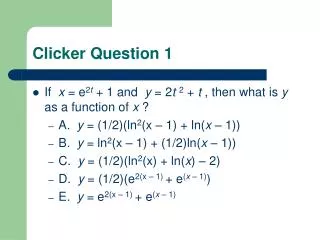
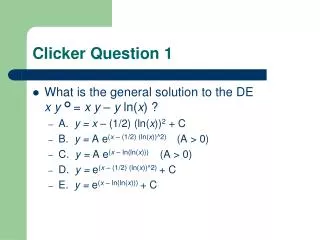
Clicker Question 1 • What is the general solution to the DEx y = xy – y ln(x) ? • A. y = x – (1/2)(ln(x))2 + C • B. y = A e(x – (1/2)(ln(x))^2) (A > 0) • C. y = A e(x – ln(ln(x))) (A > 0) • D. y = e(x – (1/2)(ln(x))^2) + C • E. y = e(x – ln(ln(x))) + C
Clicker Question 2 • What function y satisfies that its rate of change is always equal to cot(y) and y = /3 when x = 0. • A. y = arcsec(2ex) • B. y = arcsin(2x) • C. y = sec(x + /3) • D. y = arcsec((/3)ex) • E. y = arcsec(ex + 2)
Application of DE’s: Population Growth (3/26/14) • Let P be the size of a population and let t be time. For example, if the population grows at a rate proportional to its size, this say that it satisfies the DE: dP / dt = kP , k being the relative growth rate. • This is separable, and we know the general solution is P = A e kt where A is the starting population. • This is, naturally, called exponential growth.
The Logistic Model of Growth • Many populations may grow exponentially at first, but eventually that growth rate slows as capacity (space, food, etc.) is reached. • That is, as time passes, k will approach 0. • If the maximum capacity of the population is denoted M, a simple expression which approaches 0 as P approaches M is 1 – P / M .
The Logistic DE • Thus a DE which would model this “exponential growth at first but slowing of the growth rate as P approaches its maximum capacity” would be
Example • Suppose a population growing by the logistic model has a maximum capacity of 1000 and displays an initial growth rate of 8%. • Look at an Euler’s Method approximate solution assuming an initial population of 2. • Can we explicitly solve this DE? Is it separable?
Assignment for Friday • Hand-in #3 is due at class time. • Read Section 9.4 through page 608. • The logistic DE is separable. Separate it. Can you now solve it?