Download

1 / 10
100 likes | 265 Vues
Spina bifida, a congenital birth defect resulting from the incomplete closure of the embryonic neural tube, often goes undetected until ultrasound during pregnancy. This condition has various forms, including myelomeningocele, meningocele, and spina bifida occulta, each with distinct symptoms and treatment needs. Neurosurgical interventions can help manage the condition, with options for prenatal surgery available. While some patients may show no symptoms, others require ongoing support like walkers or wheelchairs. Learn more about this complex condition and its management.

E N D
Spina Bifida Haley Parent Anatomy and Physiology – A February 3, 2011
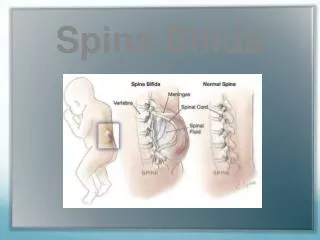
What is spina bifida? • Latin: “split spine” • Birth defect caused by the incomplete closing of the embryonic neural tube (meninges) • Embryonic neural tube: the skin that covers the brain and spinal cord. Spinal cord forms normally while meninges does not. • Vertebrae under the spinal cord are not fully formed and remain not fused and open. • If opening is large enough, a portion of the spinal cord may protrude through the opening in the bones. • A fluid sac may surround the spinal cord. • Usually detected before birth via ultra sound • The failure of the neural tube to close occurs during the first month in utero.
Types of Spina Bifida Meningocele Spina bifida occulta Spina bifida cystica Myelomeningocele
Meningocele(Meh-nin-joe-seal) Most common form of spina bifida May cause paralysis urinary or bowel dysfunction Some people do not have symptoms of spina bifida
Spina bifida occulata “Occulata” – “hidden” There is a break in the vertebrae, but it is so small the spinal cord does not protrude -skin looks normal. Most people don’t know they have it May cause back pain
Spina bifida cystica A cyst protrudes through the break in the vertebrae
Myelomeningocele Most severe form of spina bifida cystica. The nervous tissue is exposed with no membrane, which can cause life-threatening infections. The nerves in the cord are not always properly developed, and this may cause paralysis.
Treatment • Neurosurgeons can operate to close the opening in the back. • The spinal cord is put back inside the spine and covered with meninges. • Open fetal surgery can be performed if discovered before birth • Shunts may be installed to provide a constant flow of cebrospinal fluid • Some after surgery do not show signs of having spina bifida, while others may need the assistance of walkers, leg braces, wheelchairs, etc.
Bibliography http://wiki.cns.org/wiki/index.php/Spina_bifida http://kidshealth.org/parent/system/ill/spina_bifida.html http://nervous-system.emedtv.com/meningocele/meningocele.html http://www.nervous-system-diseases.com/meningocele.html http://physioforu.blogspot.com/2009/04/spina-bifida-latin-split-spine-is.html