React.js vs node.js
What is React.js & Node.js?<br>What are the features of React.js & Node.js?<br>Who user React.js & Node.js?

React.js vs node.js
E N D
Presentation Transcript
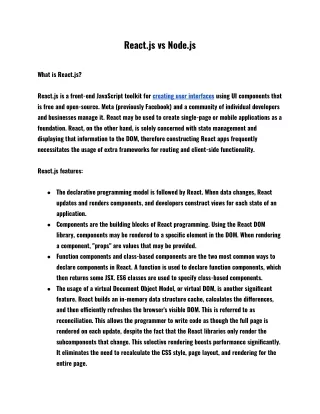
React.js vs Node.js What is React.js? React.js is a front-end JavaScript toolkit for creating user interfaces using UI components that is free and open-source. Meta (previously Facebook) and a community of individual developers and businesses manage it. React may be used to create single-page or mobile applications as a foundation. React, on the other hand, is solely concerned with state management and displaying that information to the DOM, therefore constructing React apps frequently necessitates the usage of extra frameworks for routing and client-side functionality. React.js features: ● The declarative programming model is followed by React. When data changes, React updates and renders components, and developers construct views for each state of an application. ● Components are the building blocks of React programming. Using the React DOM library, components may be rendered to a specific element in the DOM. When rendering a component, "props" are values that may be provided. ● Function components and class-based components are the two most common ways to declare components in React. A function is used to declare function components, which then returns some JSX. ES6 classes are used to specify class-based components. ● The usage of a virtual Document Object Model, or virtual DOM, is another significant feature. React builds an in-memory data structure cache, calculates the di?erences, and then e?ciently refreshes the browser's visible DOM. This is referred to as reconciliation. This allows the programmer to write code as though the full page is rendered on each update, despite the fact that the React libraries only render the subcomponents that change. This selective rendering boosts performance significantly. It eliminates the need to recalculate the CSS style, page layout, and rendering for the entire page.
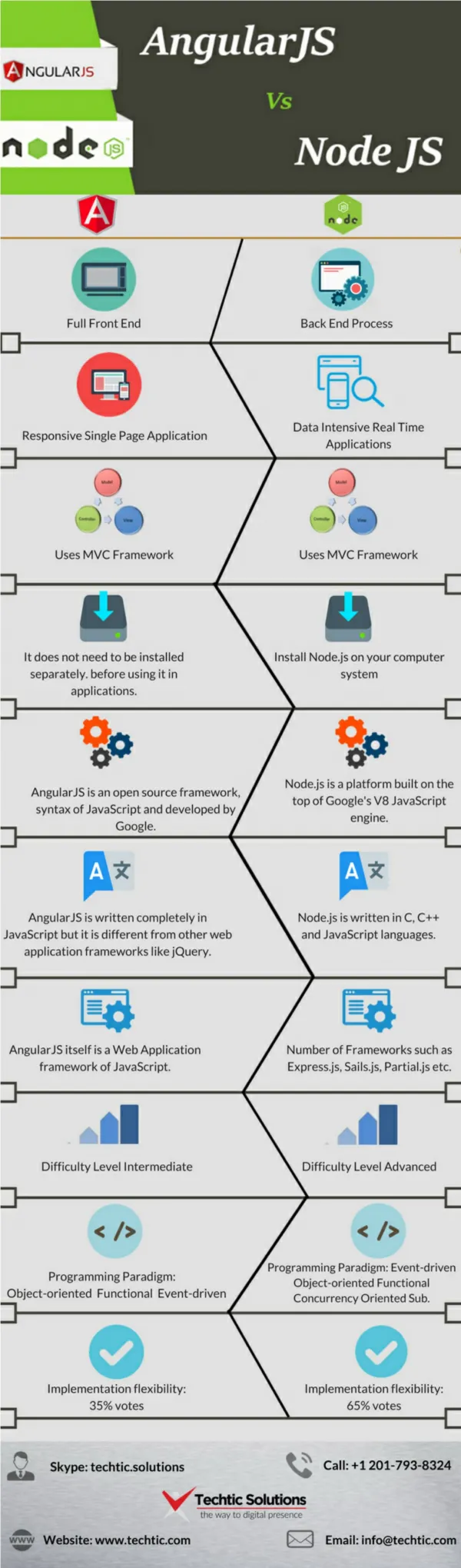
What is Node.js? Node.js is a JavaScript-based tool for creating application backends. Because it utilizes an event-driven and non-blocking I/O mechanism, Node.js is e?cient and lightweight. This framework is used by developers to host APIs, serve HTTP requests, and access the database. Node.js features ● Node.js is an open-source framework that is free to use. ● Non-blocking activities may be performed by developers, which improves the speed of online apps. ● APIs are built into Node. As a result, Node.js enables developers to create a variety of servers, including DNS servers, TCP servers, HTTP servers, and more. ● Jasmine, a unit testing framework in Node.js, allows you to easily test ready code. ● Node.js apps may be scaled in both vertical and horizontal directions to improve performance.