Download
1 / 33
330 likes | 454 Vues
This article explores the intricacies of Virtual Private Networks (VPN) and Wide Area Network (WAN) technologies. It covers different VPN types, including secure and trusted networks, highlighting protocols such as IPsec and SSL/TLS. Additionally, the document compares WAN technologies like frame relay and ISDN, and discusses T-carrier connections and DSL. Key concepts such as data integrity, encryption, and authentication are examined to understand how these technologies provide secure and efficient long-distance communication.

E N D
long-distance dial-up connection WAN technology - PSTN
Figure 7-9 A WAN using frame relay WAN technology – X.25 and Frame Relay
A BRI link A PRI link WAN technology - ISDN
CSU/DSU point-to-point T-carrier connection T-carrier connecting to a LAN through a router WAN technology T-Carrier
DSL connection DSL Connectivity
SONET ring WAN technology - SONET
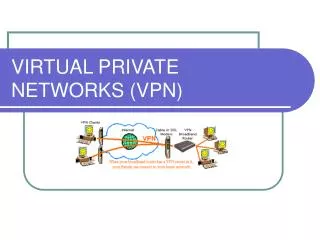
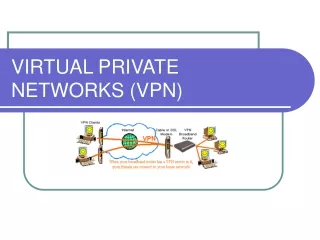
What is VPN? • Virtual Private Network is a type of private network that uses public telecommunication, such as the Internet, instead of leased lines to communicate. • Became popular as more employees worked in remote locations.
Remote Access Virtual Private Network (From Gartner Consulting)
VPN: Types • Secure VPNs use cryptographic tunneling protocols. • IPsec, SSL/TLS, OpenVPN, PPTP, L2TP, L2TPv3, VPN-Q and MPVPN • Trusted VPNs rely on the security of a single provider’s network to protect the traffic. • MPLS and L2F
Tunneling A virtual point-to-point connection made through a public network. It transports encapsulated datagrams. Original Datagram Encrypted Inner Datagram Datagram Header Outer Datagram Data Area Data Encapsulation [From Comer] Two types of end points: • Remote Access • Site-to-Site
VPN: Tunneling Figure 1
Cryptographic Tunneling Factor • Authentication – validates that the data was sent from the sender. • Access control – limiting unauthorized users from accessing the network. • Confidentiality – preventing the data to be read or copied as the data is being transported. • Data Integrity – ensuring that the data has not been altered • Cryptography Technic • Encryption -- is a method of “scrambling” data before transmitting it onto the Internet. • Public Key Encryption Technique • Digital signature – for authentication
Virtual Private Networks • VPN can be deployed in three ways : • Host to host • Site-to-Site • Host-to-Site
VPN Topology: Types of VPNs • Remote access VPN • Intranet VPN • Extranet VPN
Intro to MPLS • MPLS = Multi Protocol Label Switching • Suatumetode forwarding (meneruskan data/paketmelaluisuatujaringandenganmenggunakaninformasi label yang dilekatkanpadaI • Memungkinkan router meneruskanpaketdenganhanyamelihat label yang melekatpadapakettersebut, sehinggaptidakperlulagimelihatalamat IP tujuan)
2. ARSITEKTUR MPLS • Perpaduan mekanisme Label Swapping (Layer 2) dan Routing (Layer 3) • Terdiri atas LSR yang saling terhubung, membentuk suatu LSP • LSR pertama disebut ingress • LSR terakhir disebut egress • Bagian tepi dari jaringan LSR disebut LER Back
LSR = Label Switched Router • LSP = Label Switched Path • LER = Label Edge Router • TTL = Time to Live Back
5. OPERASI MPLS • Pembuatan label dan distribusi • Pembuatan label dalam tiap router • Pembuatan jalur label yang terhubung • Pemasukan label • Forwarding paket Back