
Learning objectives
E N D
Presentation Transcript
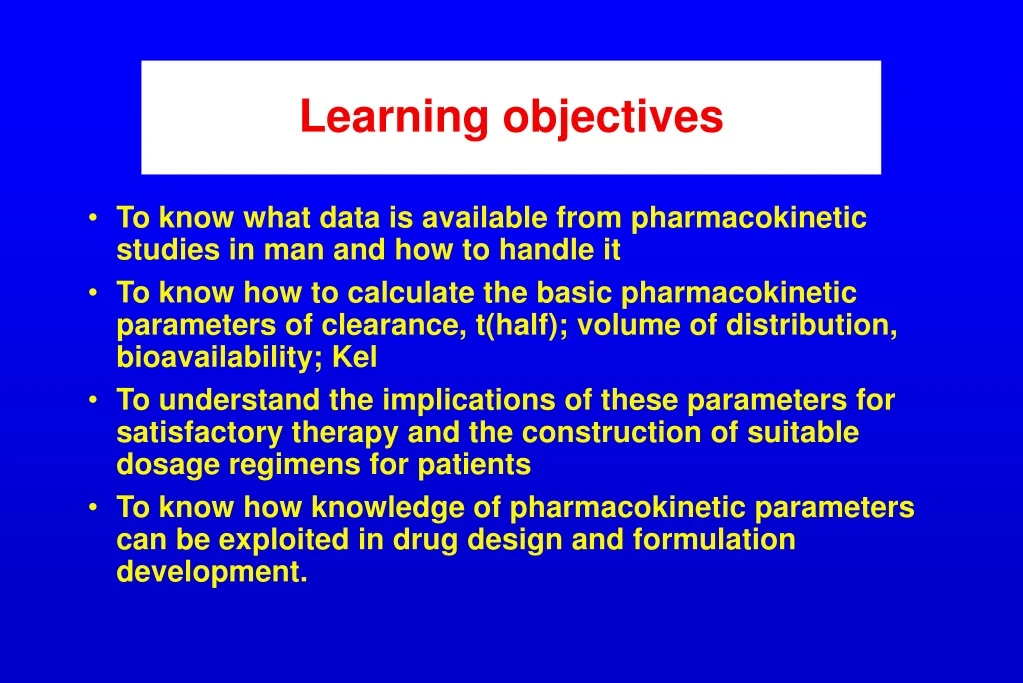
Learning objectives • To know what data is available from pharmacokinetic studies in man and how to handle it • To know how to calculate the basic pharmacokinetic parameters of clearance, t(half); volume of distribution, bioavailability; Kel • To understand the implications of these parameters for satisfactory therapy and the construction of suitable dosage regimens for patients • To know how knowledge of pharmacokinetic parameters can be exploited in drug design and formulation development.
Pharmacokinetics • Study of ADME on a quantitative basis In man study blood, urine, faeces, expired air. Measure urine volume & concentration of drug conc in urine x vol per min = RENAL plasma concentration CLEARANCE If neither secreted nor reabsorbed then clearance = clearance of inulin = 120 ml/min If completely cleared by secretion then clearance = clearance of p-hippuric acid = renal blood flow = 700 ml/min
Plasma concentration -tKel Ct=Co e lnCt = lnCo - Kel t logCt = logCo - Kel . t 2.303 y = c m x
Bioavailability Plasma concentration i.v. route (AUC)o / (AUC)iv oral route Time (hours)
=1.5;antilog 1.5 = 31.6 logCt = logCo - Kel . t 2.303 TIME (hours) log plasma concentration
Pharmacokinetic parameters • Volume of distribution V = DOSE / Co • Plasma clearance Cl = Kel .V • plasma half-life (t1/2) directly from graph or t1/2 = 0.693 / Kel • Bioavailability (AUC)x / (AUC)iv
Multiple dosing • On multiple dosing plasma concentration will rise and fall with each dose andwill increase until administration = elimination ie. steady state is reached. • At steady state hourly dose rate (D=dose; T=interval between doses in hours) D/T = clearance x plasma conc or steady state conc = D/(T x clearance) • At each dose the level will oscillate through D/V
plasma conc toxic effective Cumulation and use of loading doses Time