
“BAD” DATA
E N D
Presentation Transcript
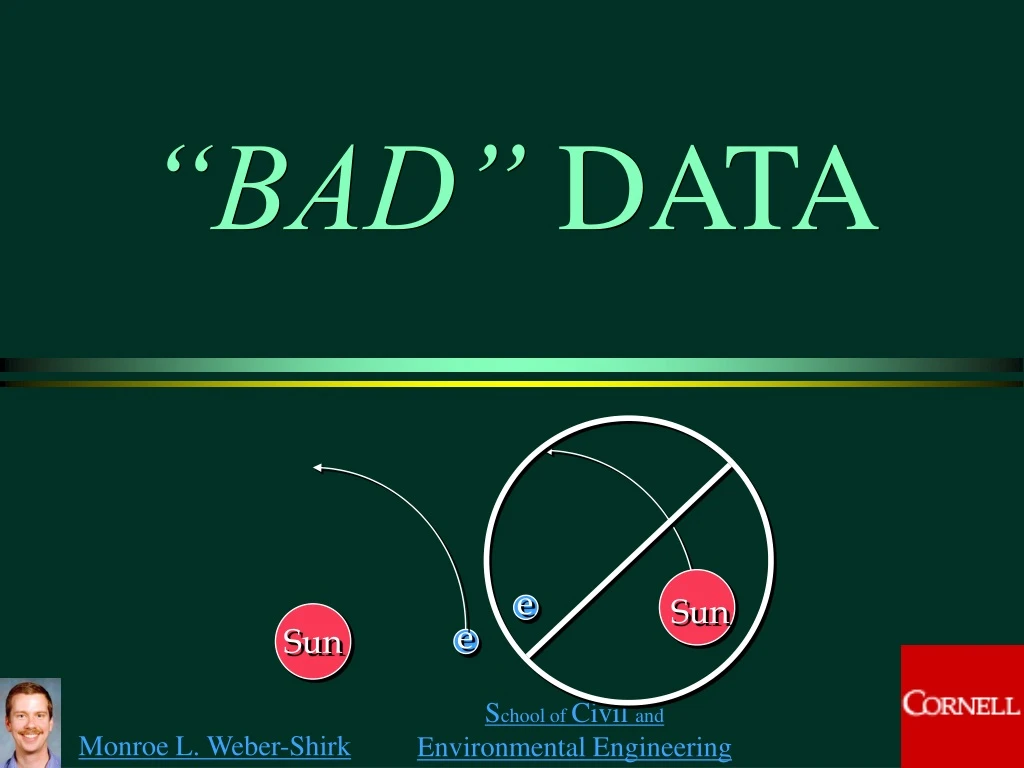
“BAD” DATA e Sun e Sun
Overview • Bad Data • Learning from unexpected results • Isotherm Analysis • Research
Sources of “Bad” Data • Error in preparation of samples • mass or volume measurement error • contamination • improper storage • sample substitution • sample loss • samples with high heterogeneity • Apparatus failures • leaks • incompatible materials • inadequate control of an important parameter
Instrument Errors • detector malfunction • below detection limit or above maximum • interference • software (instrument or computer) • hardware (analog to digital converter, power supply,...) • calibration
More sources of “Bad Data” • Error in data analysis • numerical error (data entry) • units (classic errors of factors of 10 and factors of 1000) • incorrectly applied theory • Error in theory
Bad Data aren’t Bad! • “Bad” data usually means the results were unexpected • perhaps unorthodox! • Copernicus “Concerning the Revolutions of the Celestial Bodies”1543 • Papal Index of forbidden books until 1835 • _____________________ • Data do not lie! • Data always mean something • If you ignore data that you don’t understand you are missing an opportunity to learn Bad data for 292 years!
Unexpected Results • Lack of repeatability (poor precision) • scatter for all data • outlier • systemic error
e Sun Sun e Unexpected Results • Inconsistent with theory • mass balances indicate loss or gain of mass • inconsistent with previous results
Responses to Unexpected Results • Determine accuracy of technique by analyzing known samples • Determine precision of technique by analyzing replicates • Evaluate propagation of errors through analysis • are you trying to measure the difference between two large numbers? • is the precision of the measurement similar to the magnitude of the estimate? • Are you not controlling an important parameter? • Is the parameter that you are studying insignificant?
Isotherm Analysis Pointers • Units • Express mass of VOC in grams • Express concentrations as g per mL • Remember GC injection volume was 0.1 mL • Use names to keep track of parameters in spreadsheet • Build sheet from left to right
More Pointers • Soil density = 1.6 g/mL • Soil moisture content is 13% • Soil mass was close to 20 g • Analyze the 4 data sets as sets • Use the data from one group to calculate a single value for each parameter • You will get 4 estimates for each parameter spreadsheet
water water EPICS Error Analysis • Assume 10% error in measuring gas concentrations • What are the maximum and minimum values of mass in liquid phase? low solubility high solubility (10 ± 1) – (9 ± 0.9) (10 ± 1) –( 1 ± 0.1) 11 – 8.1 = 2.9 11 – 0.9 = 10.1 9 – 9.9 = -0.9 9 – 1.1 = 7.9