Sources of Heritable Variation and Evolutionary Mechanisms in Populations
120 likes | 270 Vues
This section explores the main sources of heritable variation in populations, focusing on mutations and genetic shuffling through sexual reproduction. It defines genetic variation, populations, and gene pools, explaining how allele frequencies change over time due to natural selection and genetic drift. Additionally, it discusses the processes of speciation, including reproductive isolation and geographic barriers, illustrated through examples like Darwin’s finches. Understanding these concepts is crucial for comprehending evolutionary changes that impact various aspects of life, including drug and pesticide resistance.


Sources of Heritable Variation and Evolutionary Mechanisms in Populations
E N D
Presentation Transcript
Ch 16- Evolution of Populations • What are the main sources of heritable variation in a population? • Mutations and gene shuffling from sexual reproduction • Genetic variation= studied in populations • What is a population? • Gene pool- all genes, including different alleles, that are present in a population • Relative frequency- # of times that the allele occurs in a gene pool, compared to other alleles for same gene • Expressed as % • Nothing to do with allele being recessive or dominant • In genetic terms, evolution = any change in relative frequency of alleles in a population
Sources of Genetic Variation • Main sources of genetic variation= mutations and genetic shuffling from sexual reproduction • Mutations- any change in sequence of DNA • May affect organism’s fitness or ability to survive and reproduce • May have no effect on fitness • Gene shuffling- occurs during production of gametes • Crossing over • Sexual reproduction- major source of variation within many populations
Single-Gene and Polygenic Traits • What determines the numbers of phenotypes for a given trait? • Depends on how many genes control that trait • Single-gene trait- controlled by single gene that has two alleles • Widow’s peak • Polygenic trait- controlled by two or more genes • Two or more alleles • Many possible phenotypes and genotypes
Sec 2- Evolution as Genetic Change • Evolution- any change over time in the relative frequencies of alleles in a population • Populations evolve over time, not individuals • How does natural selection affect single-gene and polygenic traits? • On single-gene traits= can lead to changes in allele frequencies • Organism of one color may produce fewer offspring than organisms of other colors
Natural Selection on Polygenic Traits • Natural selection can affect the distributions of phenotypes by directional selection, stabilizing selection, disruptive selection • Directional selection- individuals at one end of curve have higher fitness than individuals in the middle or at end • Stabilizing selection- takes place when individuals near the center of curve have higher fitness than individuals at either end • Disruptive selection- individuals at the upper and lower ends of the curve have higher fitness than individuals near middle
Genetic Drift • Natural selection- not only source of evolutionary change • Genetic drift- random change in allele frequencies that happens in small populations • Individual with particular allele may leave more descendants than others, just by chance • Over time, series of chance occurrences of this type can cause allele to become common in population • May occur when small group of ind colonizes a new habitat • Founder effect- allele frequencies change as a result of migration of a small subgroup of a pop.
Evolution Versus Genetic Equilibrium • Hardy-Weinberg principle- allele frequencies in a pop will remain constant unless one or more factors cause those frequencies to change • Genetic equilibrium- allele frequencies remain constant • Conditions required to maintain genetic equilibrium • Random mating • Population must be large • No movement into or out of population • No mutations • No natural selection
Sec 3- Process of Speciation • Speciation- formation of new species • What must happen for a species to evolve into two new species? • Gene pools of two populations must become separated • Reproductive isolation- members of two pop cannot interbreed and produce fertile offspring • Behavioral isolation • Geographic isolation • Temporal isolation
Behavioral isolation- two populations have differences in courtship rituals or other reproductive strategies that involve behavior • Eastern and western meadowlarks • Geographic isolation- two pops are separated by geographic barriers, like rivers, mountains, bodies of water • Abert and Kaibab squirrel • Do not guarantee formation of new species • May separate some organisms but not others • Temporal isolation- two or more species reproduce at different times • Orchids in rain forest • Welcome to Discovery Education Player
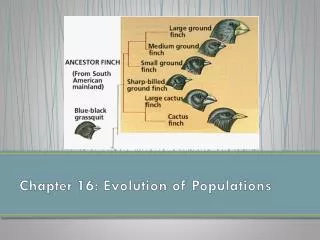
Speciation in Darwin’s Finches • How did the process of speciation in the Galapagos finches occur? • Founding of a new population • Geographic isolation • Changes in new population’s gene pool • Reproductive isolation • Ecological competition
Why is understanding evolution important? • Drug resistance in bacteria and viruses • Pesticide resistance in insects • Evolutionary theory helps us understand and respond to these changes in ways that improve human life