Importance of PAT Testing and Safety Procedures in the Workplace
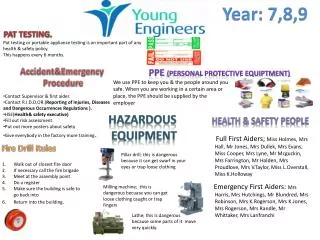
Portable Appliance Testing (PAT) is a critical aspect of health and safety compliance, conducted every six months to ensure equipment safety. Personal Protective Equipment (PPE) is vital for protecting employees in hazardous work environments. Employers are responsible for supplying PPE, along with providing adequate training and safety information. Familiarize yourself with emergency procedures, including contacting first aiders and reporting incidents according to RIDDOR regulations. Understanding the risks associated with hazardous machinery like milling machines and lathes is essential for maintaining a safe workplace.

Importance of PAT Testing and Safety Procedures in the Workplace
E N D
Presentation Transcript
Year: 7,8,9 PAT TESTING. Pat testing or portable appliance testing is an important part of any health & safety policy. This happens every 6 months. Accident&Emergency Procedure Ppe(PERSONAL PROTECTIVE EQUIPTMENT) We use PPE to keep you & the people around you safe. When you are working in a certain area or place, the PPE should be supplied by the employer • Contact Supervisor & first aider. • Contact R.I.D.D.OR.(Reporting of Injuries, Diseases and Dangerous Occurrences Regulations ). • HSE(Health& safety executive) • Fill out risk assessment. • Put out more posters about safety • Give everybody in the factory more training. Hazardous equipment Health & safety people Full First Aiders; Miss Holmes, Mrs Hall, Mr Jones, Mrs Dullek, Mrs Evans, Miss Cooper, Mrs Lyne, Mr Mcguckin, Mrs Farrington, Mr Halden, Mrs Proudlove, Mrs V.Taylor, Miss L.Overstall, Miss K.Holloway Emergency First Aiders: Mrs Harris, Mrs Hutchings, Mr Blundred, Mrs Robinson, Mrs K.Rogerson, Mrs K.Jones, Mrs Rogerson, Mrs Randle, Mr Whittaker, Mrs Lanfranchi Fire Drill Rules Pillar drill; this is dangerous because it can get swarf in your eyes or trap loose clothing Walk out of closest fire door If necessary call the fire brigade Meet at the assembly point Do a register Make sure the building is safe to go back into Return into the building. Milling machine; this is dangerous becuase you can get loose clothing caught or trap fingers Lathe; this is dangerous because some parts of it move very quickly.