Understanding the Cardiovascular System: Structure, Function, and Circulation
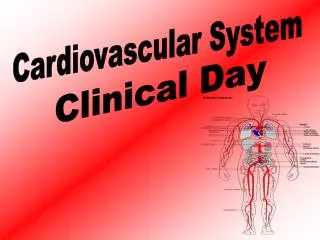
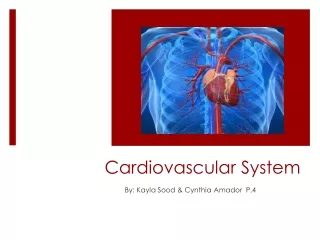
The cardiovascular system, also known as the circulatory system, comprises the heart, blood vessels, and blood. It is divided into the pulmonary and systemic circuits, crucial for efficient blood flow and oxygen transportation. The heart functions as a four-chambered muscular pump, generating blood pressure and routing blood through one-way valves to ensure proper circulation. The pericardium surrounds the heart, providing lubrication, while specialized cardiac muscle cells, intercalated discs, and pacemaker systems regulate heartbeat and blood flow. This intricate system meets the body's metabolic demands through coordinated contraction and relaxation cycles.

Understanding the Cardiovascular System: Structure, Function, and Circulation
E N D
Presentation Transcript
Cardiovascular system The term CIRCULATORY SYSTEM refers to • H E A R T • B L O O D V E S S E L S • B L O O D The term CVS refers to • HEART (4 chambered muscular pump) • Arteries • veins • Capillaries
Cardiovascular system 2 major divisions • Pulmonary circuit • Systemic circuit
Functions of the Heart • Generating blood pressure • Routing blood • Heart separates pulmonary and systemic circulations • Ensuring one-way blood flow • Heart valves ensure one-way flow • Regulating blood supply • Changes in contraction rate and force match blood delivery to changing metabolic needs
Cardiovascular system PERICARDIUM a double walled sac • Parietal • Visceral (E P I C A R D I U M ) • Pericardial cavity Is space b/w PT and VS membranes 5-30 ml of pericardial fluid Lubrication
Cardiovascular system HEART WALL • E P I C A R D I U M • M Y O C A R D I U M • E N D O C A R D I U M
Cardiovascular system V A L V E S Heart needs valves that ensures a predominantly ONE-WAY flow Opening and closing is the result of pressure gradients b/w the UPSTREAM and DOWNSTREAM sides of the valve
RA ----- right AV valve ---- right ventricle ----- pulmonary valve ----- pulmonary trunk ---- pulmonary arteries to lungs pulmonary veins returning from lungs ---- LA ---- left AV valve ---- LV ---- aortic valve ---- aorta --- other systemic vessels - IVC / SVC ----- back to RA Cardiovascular system P A T H W A Y O F B L O O D
OPERATION OF HEART VALVES • Ventricular pressure greater than artery pressure • The valve is forced open • Blood is ejected
OPWERATION OF HEART VALVES • Ventricular pressure lower than arterial pressure • Arterial blood holds the valve closed
OPWERATION OF HEART VALVES • Arterial pressure greater than ventricular pressure • Valve open and blood flows through
OPWERATION OF HEART VALVES • Ventricular pressure rises above arterial pressure • The blood in the ventricle pushes the valve cusps closed
Cardiac muscle • Cardiac myocytes (cardiocytes) are shorter and thicker • Each myocyte linked to several others at its ends • The linkages are called I n t e r c a l a t e d d i s c s
Cardiac muscle an intercalated disc has • electricalgap junctions That allows each myocyte to directly stimulate its neighbors • mechanical junctions (DESMOSOMES) Keep myocytes from pulling apartwhen heart contracts
Cardiac muscle • Sarcoplasmic reticulum is less developed than sk. M • T tubules are larger and admit supplemental Calcium from ECF • It contains built-in P A C E M A K E R that rhythmically sets off a wave of electrical excitation ( A U T O R H Y T H M I C )
Cardiac muscle • Cardiac muscle doesn’t exhibit quick twitches like Sk. M • Cardiac muscle uses aerobic respiration almost exclusively • Rich in myoglobin and glycogen