Download
1 / 21
210 likes | 338 Vues
This presentation by Dr. William Koshak at the GLM Science Meeting focuses on the Ground Flash Fraction Retrieval Algorithm. The talk explores the algorithm's application in improving air quality models and understanding the effects of lightning on global chemistry and climate models. It tackles the complexities of the inversion problem, examining the reconstruction of lightning channel intensity using historical data and advanced mathematical techniques. Key findings from past studies and the application of Bayesian inversion methods for flash-type discrimination are also discussed.

E N D
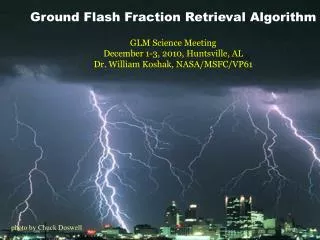
Ground Flash Fraction Retrieval Algorithm GLM Science Meeting December 1-3, 2010, Huntsville, AL Dr. William Koshak, NASA/MSFC/VP61 photo by Chuck Doswell
Desired Future Application # GLM Flashes Ground Flash Fraction Retrieval Algorithm (today’s talk) # GLM Ground Flashes # GLM Cloud Flashes MSFC LNOM (lightning NOx) Air Quality Models (e.g. CMAQ) Global Chemistry/Climate Models (e.g. GISS Model E, GeosChem)
Algorithm is used to solve an Inversion Problem Unknown Measurements K (Kernel) (Footprints) (Dragon)
Consider a (linear) Optics Analog Mueller Matrix: A matrix which can be used to reproduce the effect of a given optical element when applied to aStokes vector. Source observer Optical Elements K Optical Element Mueller Matrix (Singular) Linear horizontal polarizer Right-handed circular polarizer
In Reality: Multiple Scattering Medium
Actual Forward Multiple Scattering Problem
Eqs. (21) is the Forward Problem … it’s ugly. Inverse Problem is uglier.
Is there a channel to ground? Formal Inverse Problem: Reconstruct Channel from Intensity
Historical Recap • Several studied the forward problem • Thomason & Krider 1982 (Monte Carlo) • Koshak et al. 1994 (Boltzmann Diffusion) • Suszcynsky et al. 2000 (optical & vhf data, not theory) • Light et al. 2001 (Monte Carlo) • Davis & Marshak 2002 (Green’s functions) • Nobody published the inverse problem for channel • reconstruction; flash-by-flash-discrimination (FBFD) • Neural Net (Boccippio … unknown status); probabilistic FBFD • Bayesian Inversion (Koshak); ground flash fraction retrieval
Use just 1 physical parameter Find & examine the “group” in the flash having the Maximum Area.
Distributions of the Maximum Group Area (MGA) Ground Flashes Cloud Flashes
Shifted MGA y = MGA – 64 km2
Retrieval Errors with Increasing N (N = # flashes observed)
Improvements using Normal Priors P(α, µg , µc)= P(α)P(µg)P(µc) = 1·P(µg)P(µc) Priors P(µg) and P(µc) are Uniformly Distributed Priors P(µg) and P(µc) are Normally Distributed
For More Details … Koshak, W. J., Optical Characteristics of OTD Flashes and the Implications for Flash-Type Discrimination, J. Atmos. Oceanic Technol., 27, 1822-1838, 2010. (November issue) Koshak, W. J., R. J. Solakiewicz, Retrieving the Fraction of Ground Flashes from Satellite Lightning Imager Data Using CONUS-Based Optical Statistics, accepted in J. Atmos. Oceanic Technol., August 30, 2010. Koshak, W. J., A Mixed Exponential Distribution Model for Retrieving Ground Flash Fraction from Satellite Lightning Imager Data, accepted in J. Atmos. Oceanic Technol., August 30, 2010.