Download
1 / 7
70 likes | 171 Vues
Join the Environmental Control Studio at the Department of Architecture, International Burch University. This course (ARC 254) focuses on building environmental controls relevant to architectural planning and design. Through integrated design approaches, students will learn how environmental issues influence the design process from site exploration to final construction. Key topics include environmental control systems, renewable technologies, passive design strategies, and energy-efficient architecture, preparing students for sustainable architectural practices.

E N D
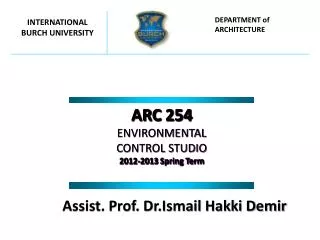
DEPARTMENT of ARCHITECTURE INTERNATIONAL BURCH UNIVERSITY ARC 254 ENVIRONMENTALCONTROL STUDIO 2012-2013SpringTerm Assist. Prof. Dr.Ismail Hakki Demir
Class Schedule: Thursday 9:00 - 11:00 • Office Hour: Monday 11:00 - 13:00 Friday 9:00 - 12:00
Course Objectives • Students will be provided with knowledge on aspects of building environment controls related to architectural planning and design. • This course will introduce students in integrated design approach. They will understand how the environmental issues impact on design process from initial site explorations to final construct detail. • To understand the functions and characteristics of environmental control systems and their place in the development of architectural concepts; • Eviromental control studio teachs students meaning of design concept, through visual, spatial, and performance parts.
Textbooks • Mat Santamouris, Environmental Design of Urban buildings: An Integrated Approach • Moore, Fuller, Environmental control systems: heating, cooling, lighting. McGraw-Hill, 1993. • Baird, George, The Architectural Expression of Environmental Control Systems,Taylor & Francis , 2001. • Peter F. Smith , Arhitecture in a climat of change . A guide to sustainable design . 2005 • Craig Di Louie, Advanced lighting controls , Energy savings , Productivity, Technology and Application , 2006 • Lyle, John, Regenerative Design for Sustainable Development. New York: John Wiley & Sons, 1994 • Mazria, Edward, The Passive Solar Energy Book. Emmaus, Penn.: Rodale Press, 1979 • Vale, Brenda and Robert, Green Architecture. Boston: Bullfinch Press, 1991 • Watson, Don & Kenneth Labs, Climatic Design. San Francisco: McGraw-Hill, 1983
Brief Contents • Architectural form as an environmental control system. CLIMATE as a context • DESIGN STRATEGIES • The Luminous Environment. Fundamentals of LIGHT • ACOUSTICS Design • RENEWABLE TECHNOLOGIES • Sustainable design. PASSIVE SYSTEM. Passive house • EXISTING housing: a challenge and opportunity. • HVAC System • Energy sources • Water and Wind in Architecture
Grading • Attendance 5% • Activity and participation 5% • Studio project 40% • Midterm Exam 20% • Final Exam 30%
Presentation • Architectural form as an environmental control system. • CLIMATE as a context • DESIGN STRATEGIES • The Luminous Environment. Fundamentals of LIGHT • ACOUSTICS Design • RENEWABLE TECHNOLOGIES • Sustainable design. PASSIVE SYSTEM. Passive house • EXISTING housing: a challenge and opportunity. • HVAC System • Natural Ventilation • HVAC : VENTILATION • HVAC: HEATING & COOLING SYSTEMS • Indoor Air Quality - IAQ • Energy sources • Building design and energy strategies. • Water and Wind in Architecture