Download
1 / 25
250 likes | 374 Vues
Dive into the world of dimensional analysis and conversion factors through practical examples. This guide focuses on equivalence statements that demonstrate the relation between different units. Learn how to create conversion factors from equivalence statements and apply them to convert measurements like speed and volume. With engaging activities, including converting hours to minutes and exploring various measurement units, you’ll gain a strong foundation in using these concepts effectively for real-life applications.

E N D
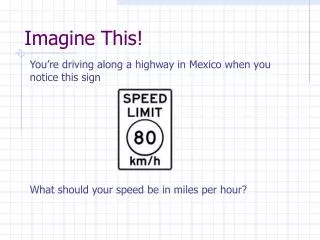
Imagine This! You’re driving along a highway in Mexico when you notice this sign What should your speed be in miles per hour?
Dimensional Analysis Equivalence Statements, & Conversion Factors
I) Equivalence Statements • An equivalence statement shows two quantities with different units that are equal to each other.
Equivalence Statements • A) equivalence statements can be counted numbers: • Examples: • 1 dozen eggs = 12 eggs • 1 pair of shoes = 2 shoes
Equivalence Statements • B) equivalence statements can be numbers with in the same measurement system: Examples: • 1 km = 1000m • 5280 feet = 1 mile
Equivalence Statements • C) equivalence statements can be numbers in different measurement systems: Examples: • 1 lb = 2.21 kg • 1 in = 2.540 cm
Equivalence Statements • D) equivalence statements can be numbers that are specific to a situation: Examples: • 1 in = 50 km such as on a map 1m = 3.45cm such as in a photograph • 3 students = 1 lab group such as during a particular lab
Practice:Design four equivalence statements and write them on your paper:
II) Conversion Factors A) Conversion factors are a set of fractions that ALWAYS equal one. The numerator and the denominator have equal value.
II) Conversion Factors B) Every equivalence statement can be used to construct 2 conversion factors.
Practice: • Write the two conversion factors for the equivalent statement below: equivalence statements 13 steps = 1 flight of stairs
II) Conversion Factors • Use background information sheet (equivalent statements) to write base conversion factors.
III) Using Conversion Factors for Dimensional Analysis A) What happens to the value of a number when you multiply it by one?
III) Using Conversion Factors for Dimensional Analysis B) Because a conversion factor is a fraction that equals one, when it is used in a calculation it does not effect the value of the number, however, it does change the units.
III) Using Conversion Factors for Dimensional Analysis C) Dimensional analysis is the process by which a conversion factor is used to convert a value from one unit to another.
III) Using Conversion Factors for Dimensional Analysis D) To decide which of the two conversion factors to use make sure the units from the known value will cancel leaving units for the unknown value.
DO IT!! Convert 3.5 hours to minutes: • Write down the given information and put it over 1.
DO IT!! • Get up a conversion factor such that the information in the numerator and denominator equal each other. 3.5 hrs 1
DO IT!! • Cancel the units 3.5 hrs X 60 min 1 1 hrs
DO IT!! • Multiply the numerators. 3.5 hrs X 60 min = 210 min 1 1hr
DO IT!! • Multiply the denominators 3.5 hrs X 60 min = 210 min 1 1hr 1
DO IT!! • Divide your final answer and include the new units. 3.5 hrs X 60 min = 210 min = 210min 1 1hr 1
Practice: • convert 27.5 L to mL