Reference frames in Geodetic Analyses Two aspects
Understand geodetic reference frames, their applications in Western Turkey and Aegean, and the challenges faced in defining frames for time series data processing and analysis.<br>

Reference frames in Geodetic Analyses Two aspects
E N D
Presentation Transcript
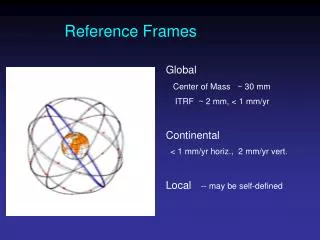
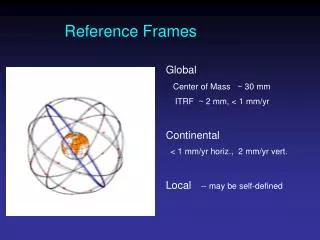
Reference frames in Geodetic Analyses Two aspects • Theoretical (e.g., rigid block, mantle-fixed, no-net-rotation of plates) • Realization through a set of coordinates and velocities Three considerations in data processing and analysis • Consistent with GPS orbits and EOP (NNR) -- not an issue if network small or if orbits and EOP estimated • Physically meaningful frame in which to visualize site motions • Robust realization for velocities and/or time series
DefiningReference Frames in GLOBK • Three approaches to reference frame definition in GLOBK • Finite constraints ( in globk, same as GAMIT ) • Generalized constraints in 3-D ( in glorg ) • Generalized constraints for horizontal blocks (‘plate’ feature of glorg) • Reference frame for time series
Frame definition with finite constraints Applied in globk (glorg not called) apr_file itrf05.apr apr_neu all 10 10 10 1 1 1 apr_neu algo .005 005 .010 .001 .001 .003 apr_neu pie1 .005 005 .010 .001 .001 .003 apr_neu drao .005 005 .010 .001 .001 .003 … • Most useful when only one or two reference sites • Disadvantage for large networks is that a bad a priori coordinates or bad data from a reference site can distort the network
Frame definition with generalized constraints Applied in glorg: minimize residuals of reference sites while estimating translation, rotation, and/or scale (3 -7 parameters) apr_file itrf05.apr pos_org xtran ytran ztran xrot yrot zrot stab_site algo pie1 drao … cnd_hgtv 10 10 0.8 3. • All reference coordinates free to adjust (anomalies more apparent); outliers can be automatically removed • Network can translate and rotate but not distort • Works best with strong redundancy (number and [if rotation] geometry of coordinates exceeds number of parameters estimated) • Can downweight heights if suspect
Referencing to a horizontal block (‘plate’) Applied in glorg: first stabilize in the usual way with respect to a reference set of coordinates and velocities (e.g. ITRF), then define one or more ‘rigid’ blocks apr_file itrf05.apr pos_org xtran ytran ztran xrot yrot zrot stab_site algo pie1 nlib drao gold sni1 mkea chat cnd_hgtv 10 10 0.8 3. plate noam algo pie1 nlib plate pcfc sni1 mkea chat After stabilization, glorg will estimate a rotation vector (‘Euler pole’) for each plate with respect to the frame of the full stabilization set. Use sh_org2vel to extract the velocities of all sites with respect to each plate
Reference Frames in Time Series Example from southwest China Stabilization with respect to a pan-Eurasia station set Stabilization with respect to a SW-China station set: spatially correlated noise reduced
.. Same two solutions, East component Eurasia stabilization SW-China stabilization 1993: noise spatially correlated 1994: noise local
Stabilization Challenges for Time Series translation+rotation; heights unweighted “Adequate” stab_site list Day 176: ALGO PIE1 DRAO WILL ALBH NANO rms 1.5 mm Day 177 ALGO NLIB CHUR PIE1 YELL DRAO WILL ALBH NANO rms 2.3 mm Indequate stab_site list Day 176: BRMU PIE1 WILL rms 0.4 mm Day 177 BRMU ALGO NLIB PIE1 YELL WILL rms 2.0 mm ^ ^ ^ ^ ^ ^ ^ ^
Rules for Stabilization of Time Series • Small-extent network: translation-only in glorg, must constrain EOP in globk • Large-extent network: translation+rotation, must keep EOP loose in globk; if scale estimated in glorg, must estimate scale in globk • 1st pass for editing: - “Adequate” stab_site list of stations with accurate a priori coordinates and velocities and available most days - Keep in mind deficiencies in the list • Final pass for presentation / assessment / statistics - Robust stab_site list of all/most stations in network, with coordinates and velocities determined from the final velocity solution