
Comparison of Horizontal Stiffness in Wheelchair Seat Cushions by Construction Material
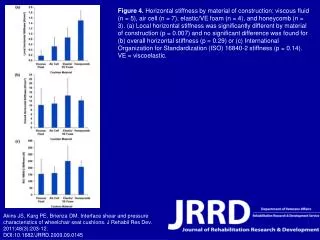
This study investigates local horizontal stiffness across different construction materials for wheelchair seat cushions, including viscous fluid (n=5), air cells (n=7), elastic/viscoelastic foam (n=4), and honeycomb (n=3). Results indicated that local horizontal stiffness varied significantly by material (p=0.007), while no significant differences were observed for overall horizontal stiffness (p=0.29) or ISO 16840-2 stiffness (p=0.14). Understanding these variations can help in the design of more effective wheelchair cushions for improved user comfort and pressure distribution.

Comparison of Horizontal Stiffness in Wheelchair Seat Cushions by Construction Material
E N D
Presentation Transcript
Figure 4. Horizontal stiffness by material of construction: viscous fluid (n = 5), air cell (n = 7), elastic/VE foam (n = 4), and honeycomb (n = 3). (a) Local horizontal stiffness was significantly different by material of construction (p = 0.007) and no significant difference was found for (b) overall horizontal stiffness (p = 0.29) or (c) International Organization for Standardization (ISO) 16840-2 stiffness (p = 0.14). VE = viscoelastic. Akins JS, Karg PE, Brienza DM. Interface shear and pressure characteristics of wheelchair seat cushions. J Rehabil Res Dev. 2011;48(3):203-12.DOI:10.1682/JRRD.2009.09.0145