Determining Resultant Forces: Graphical and Analytical Methods
This guide explores how to determine the resultant force in both graphical (parallelogram method) and analytical calculations. We analyze forces acting on a mass on a table, applying principles from physics to calculate magnitudes and directions. Example values provided include forces F1 and F2 with respective angles. The analytical method uses cosine and sine components to derive the resultant force, showcasing both steps and formulas used to achieve final results. Understanding these calculations is crucial for solving static equilibrium problems.

Determining Resultant Forces: Graphical and Analytical Methods
E N D
Presentation Transcript
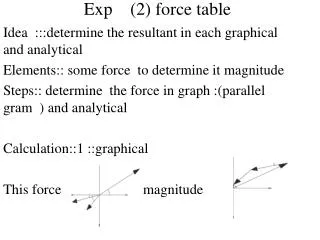
Exp (2) force table Idea :::determine the resultant in each graphical and analytical Elements:: some force to determine it magnitude Steps:: determine the force in graph :(parallel gram ) and analytical Calculation::1 ::graphical This force magnitude
for tow force mag
F1 =15n 60 15 30 F2 =8n • In analytical Fx = f1cos60 –f2cos 15 –f3cos30 = 15*0.5-8*0.96-10*0.86=-8.78 n - for direction Fy =f1sin60-f2sin15-f3sin30 =15*0.86-8*0.258-10*0.5=5.9n F mag=Fx+Fy =-8.78+5.9=-2.88n direction is tan-1=Fx =8.78/5.9=1.488== @ =81.86 F3 =10n Fy
Results :::Force table We will have three mass on a table like this We will remove the mass until the cycle be in the median and we will take our notes in sketch
F1 =1.25*9.8=1.2 F2=2.50*2.45=6.125 F2 =2.50*2.45=6.125