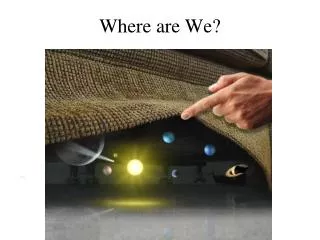
Where are We?
220 likes | 349 Vues
Explore the dynamics of Earth's rotation and revolution, delving into the effects these motions have on our perception of time, day and night cycles, and seasonal changes. Earth rotates on its axis every 23 hours and 56 minutes, affecting the Coriolis effect and the apparent shift of stars in the sky. It also orbits the Sun over 365.25 days at a velocity of 30 km/sec, impacting the tilt and seasonal variations. Learn about the vast universe, galaxies, and celestial bodies, revealing the intriguing nature of space.


Where are We?
E N D
Presentation Transcript
Rotation • Rotate • Period • 23h:56m • 24h • Day • Velocity • 0 to 40,000 km/day • 0 to 24,000 mi/24h
Rotation • Effect • Day/night • Coriolis Effect • Objects moving are deflected to the right of their intended path
Rotation • Effect • Shift of stars in sky • Direction • CCW when viewed from north
Revolution • Travel Around • Period • 365.25 days • Year • Velocity • 30 km/sec • 18.5 mi/sec
Revolution • Effect • Shift in position of stars in the sky. • with tilt = seasons • Direction • Counterclockwise when viewed from the north.
Stars • Size • Mass • Color • Age
Space is really really really really big and very very very empty.
Universe Hubble Deep Space
Universe • Relative Sizes • Power of Ten • Journey to the Edge