REDOX REACTIONS
180 likes | 313 Vues
This guide covers the fundamental concepts of redox reactions, quantifying oxidation numbers, and balancing reactions. It outlines key rules such as the oxidation number of free elements being zero and provides examples of oxidation and reduction half-reactions. Learn to identify oxidizing and reducing agents, and how to apply the shorthand method for voltaic cells. Instructions for calculating standard cell potentials are included, alongside practical examples to predict the spontaneity of reactions. Enhance your grasp of electrochemistry principles.


REDOX REACTIONS
E N D
Presentation Transcript
OXIDATION NUMBERS • THE APPARENT CHARGE ON AN ATOM • RULES • The oxidation number on any free element is zero • The oxidation number of a monatomic ion is equal to the charge on the ion • The oxidation number of Hydrogen in most compounds is +1 • The oxidation number of Oxygen in most compounds is -2 • The sum of the oxidation numbers of all the atoms in a particle must be equal to the apparent charge of that particle.
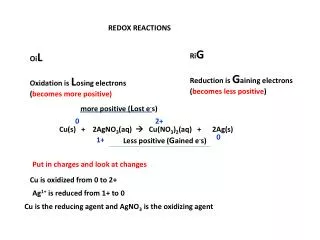
Determine the Oxidation Numbers for each of the atoms in the following reactions • H2SO4 + NaOH Na2SO4 + H2O • Cu + AgNO3 Cu(NO3)2 + Ag • Redox Reaction - a reaction in which electrons are transferred (ox. # change)
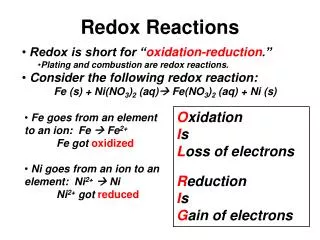
REDUCTION = The gain of electrons by atoms or ions • OXIDATION = The loss of electrons from an atom or ion • LEO goes GER • Oxidizing agent – a substance that tends to gains electrons • Reducing agent – a substance that tends to lose electrons
Identifying Oxidizing and Reducing Agents • Cu + HNO3 Cu(NO3)2 + NO + H2O • H2S + Br2 S + 2HBr • 2H2 + O2 2H2O
Rules for writing ionic equations • Binary acids: • HCl, HBr and HI are strong acids and are written as ions All other binary acids are written in molecular form • Ternary acids: • If the number of oxygen atoms exceeds the number of hydrogen atoms by two or more, the acid is strong and is written as ions • Polyprotic acids: • In the second and subsequent ionizations the acid is weak and written in molecular form • Bases: • Hydroxides of group I and II are strong and are written as ions • Salts: • Solubility rules! • Gases: • Gases are always written in molecular form
BALANCING REDOX REACTIONS • Write the skeleton equations for the oxidation and reduction half reactions • Balance the half reactions with respect to electrons • Balance all the atoms except hydrogen and oxygen • Balance oxygen by adding H2O • Balance the hydrogen atoms by adding H+ • Check to see that the charges are balanced • Balance the total number of electrons in the two half reactions by multiplying by the factor finding the least common multiple of electrons lost and gained. • Add the two half reactions and simplify • Perform a final check on the equation to make sure that the number of atoms and the charge are balanced
VOLTAIC CELLS • A voltaic cell is a device used to produce electric energy from an oxidation-reduction reaction • Anode compartment – oxidation half reaction • Cathode compartment – reduction half reaction • Shorthand method of representing cell reactions • The oxidation half reaction is written first • The reduction half reaction is written second • Two vertical lines separate the half reaction and represents the salt bridge.
STANDARD CELL POTENTIALS • Standard cell potential (Eocell) is the measured cell potential when the ion concentrations in the half cells are 1M and at 25oC and 101 kPa. • Eocell = Eoreduction – Eooxidation • Half cell potentials are read of a table
CALCULATING STANDARD CELL POTENTIALS • A voltaic cell is constructed using the following half reactions • Fe3+(aq) + e- Fe2+(aq) • Ni2+(aq) + 2e- Ni(s) • Determine the cell reaction and calculate the standard cell potential • Look up reduction potentials on the table • EoFe3+ = + 0.771 V • EoNi3+ = -0.257 V
The half cell with the more positive reduction potential is the one in which reduction occurs. (this is the cathode) • The oxidation occurs at the anode • Add the half reactions together • Make sure the e- lost equals e- • Calculate the standard cell potential • Eocell = Eoreduction – Eooxidation
Oxidation (at anode) • Ni(s) Ni2+(aq) + 2e- • Reduction (at cathode) • Fe3+(aq) + e- Fe2+(aq) • Ni(s) + 2Fe3+(aq) Ni2+(aq) + 2Fe2+(aq) • Eocell = Eoreduction – Eooxidation +0.771 V - (-0.257 V) +1.028V *Eo is not multiplied by any number even if the half reaction is!
Try these • Copper (II) ion to copper • Aluminium ions to aluminum atoms • Silver ions to silver • Copper (II) ions to copper
A strip of copper is immersed in a solution containing zinc ions. Does the reaction occur? • Cu + Zn2+ Cu2+ + Zn • Remember: • Eocell = Eoreduction – Eooxidation • A spontaneous reaction must have a positive voltage • Zn2+ + 2e- Zn -0.7626 V • Cu2+ + 2e- Cu +0.340 V • Eocell = -0.7626 – (+0.340) • This reaction will not occur because the voltage is negative, the reverse reaction will occur.
A strip of cobolt metal is immersed in a solution containing silver ions. Does the reaction occur? • Co + Ag+ Co2+ + Ag • Ag+ + 1e- Ag +0.799 V • Co2+ + 2e- Co -0.277 V • Eocell = Eoreduction – Eooxidation • Eocell = 0.799 – (-0.277) • + 1.076 V
Predict the voltage produced by the following cells • Zn/Zn2+//Fe2+/Fe • Mn/Mn2+//Br2/Br- • Cu/Cu2+//Ag+/Ag