Transcendentalism
100 likes | 241 Vues
Transcendentalism. By: Grace Martin Jordyn Rakowski. What is Transcendentalism?. The idea that everybody has knowledge about themselves and the world around them that is beyond the senses. comes through intuition and imagination


Transcendentalism
E N D
Presentation Transcript
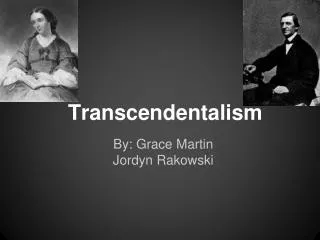
Transcendentalism By: Grace Martin Jordyn Rakowski
What is Transcendentalism? The idea that everybody has knowledge about themselves and the world around them that is beyond the senses. • comes through intuition and imagination • people can trust themselves to be own authority on what is right Transcendentalists use these ideas as a way of understanding life's relationships
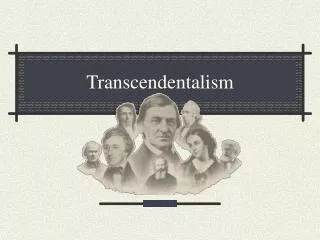
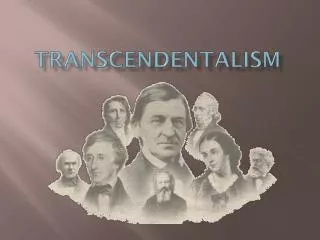
Transcendentalists • mostly New Englanders • around Boston • attempting to create an American body of literature • struggled to define spirituality and religion • that took into account the new understandings of the age • Why waste the gifts of intuition, insight, and inspiration? • read Hindu and Buddhist scriptures to examine own religion
Ralph Waldo Emerson Background • Born in 1803 on May 25th to Rev. William Emerson and Ruth Haskins Emerson • fourth of eight children • His father • was a minister from a line of ministers • was the founder of the Philosophical Society • a leading member of the Anthology Club • He was eight when his father died • left family poor • had to take turns going to school • aunt came to live with them
Schooling • went to school before 3 years old • was not a brilliant scholar • went to a Latin School • also would go to a private school and learn to write and cipher • skipping school = imprisonment with bread and water • studied at Harvard - graduated at 18 • earned the President's Freshman - free charge for school • taught at a girls school for a few years • didn't care for it • 1825- entered Harvard Divinity School
Emerson Continued • 1829- became Unitarian Minister • 1832- resigned from the church due to doubts • influenced by the writings of Poetry, Philosophy and Essays - some that were influenced by the "Transcendentalism" of Immanuel Kant • 1836-helped begin the Transcendental Club • published "Nature" • wrote for The Dial - 1842 - became its editor • 1850-the Fugitive Slave Act-
(Sarah) Margaret Fuller Background • Born May 23, 1810 in Cambridgeport, MA to Timothy Fuller and Margaret Crane Fuller • First of Four children • Her Father • an attorney • than is elected to the Massachusetts Senate • finally is elected to the U. S. Congress • left to serve at Washington and sent letters back and forth to her • later serves term Speaker of the House
Schooling • At age 4 her father educates her as if she were boy preparing to enter Harvard College • Age 10 attends Cambridge Port Private Grammar School • Age 14 attends Miss Susan Prescott’s Young Ladies’ Seminary and returns to Port • Stops attending The Port School and creates a “self-designed, self-taught curriculum” • Teaches at Temple School in Boston
Fuller Continued • 1834-writes a critique of an article on slavery and published in the Boston Daily Advertiser • Father dies when she is age 25 • Ralph Waldo Emerson invites Margaret to his home • Starts publishing in many papers • 1837- joins Transcendental club • 1842- became editor of The Dial • 1843- publishes "The Great Lawsuit: Man vs. Men and Woman vs. Women" • 1845- publishes Women in the Nineteenth Century and it urged women's rights movement
Bibliography http://www.transcendentalists.com/1emerson.html http://womenshistory.about.com/bltranscend.htm http://www.transcendentalists.com/transcendentalism.htm http://www.margaretfuller.org/index.php?option=com_content&view=article&id=58:margaret-fuller-timeline&catid=45:about-margaret&Itemid=41 http://www.biography.com/people/margaret-fuller-9303889 http://www25.uua.org/uuhs/duub/articles/margaretfuller.html