Download
1 / 32
320 likes | 440 Vues
The Pompeys Pillar Interpretive Center, a National Historic Landmark, enriches understanding of the area's cultural, historical, and environmental significance. Initiated by the BLM in 1991, the development of this facility aims to improve visitor experience while fostering local economic growth. The new center, with a focus on outdoor educational experiences, will emphasize the themes of the Lewis and Clark Expedition, Native American history, and regional ecology. With funding and community support, the center is positioned as an important stop for cultural tourism in Eastern Montana.

E N D
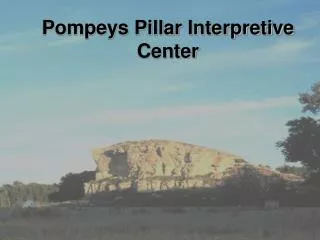
Pompeys Pillar • National Monument • National Historic Landmark • Area of Critical Environmental Concern (ACEC)
Background • 1991 - BLM acquired Pompeys Pillar • 1996 - Decision to construct an interpretive facility • 1999 - $2m from Congress to be matched by private funds • PPHA provides staff/funding support • Recently modified ‘96 decisions • Proposal to build a more modest facility • 2002 - $2.9m appropriation
BLM Concerns • Costs: construction/long-term O&M • Visitation • Riparian Area • Cultural, Historic & Scenic Values
Planned Construction • Facility Development (5,700 s.f.) • Potential for future expansion • Day use area located NW of center • Flexible season of use • New entrance road; adequate parking
The Visitor Experience • With a smaller facility, limitations on indoor interpretation • Focus on outdoor experiences (interp., educational, etc.). • Potential for future expansion would be a function of funding and visitor demand.
Interpretive Themes • Primary Theme: Clark on the Yellowstone • Sub-Themes • Native American history (Crow) • L&C Expedition • Post Expedition
Design/Development • Finalize design and interpretive exhibits • Pompeys Pillar Historical Association to raise matching funds • Target ground-breaking in 2003 • Target completion date in 2005
Benefits • Enhance local economic opportunities • Create another “stopping point” in Eastern Montana • Enhanced recreational and educational experiences • Phased-in/Planned development • Utility beyond the Bicentennial
Fort Benton is start of the Wild & Scenic River • Two river launches • Motorized launch • Non-motorized launch by fairgrounds
Existing Visitor Contact Station: • Occupies a 110 year old residence • About 1,000 s.f. • River Info; visitor check-in/logs • Displays and Offices
Background • 1980’s – Community initiated efforts for a new center • 2001 - $400k approp. for A&E • 2001 – Signed MOU • 2002 - $2.5m appropriated for construction
Registered Floaters 2001 = 5,735 2000 = 5,090 1999 = 5,442 1998 = 4,339 Center Visits 2001 = 5,463 2000 = 5,225 1999 = 4,383 1998 = 4,625 Visitation
Planning Effort • Proposed site at Water Treatment Facility • 6,000 s.f. facility • Site will be donated to BLM by the City • Analysis available for public review mid-spring
Moving Forward • Interpretive themes • River/Monument; • Fort Benton’s role as trading/distribution point • River and Plains Society is donating $1m toward Interpretive Exhibits • Construction in 2003 • Collaborative effort
Benefits • Economic stimulus in local economy • Provide information • Local area and History • River etiquette • Public launch/camping • Stewardship • Create opportunities for cultural tourism