Chemical Reactions
This text investigates how evidence of chemical reactions indicates the formation of new substances with distinct properties. It details the differences between chemical and physical changes, providing examples such as rusting, burning, and digesting food. Key signs of a chemical reaction include color change, gas production, energy change, and precipitate formation. Understanding these signs helps identify when a chemical reaction has occurred, emphasizing the importance of recognizing the creation of new substances with different chemical and physical properties.

Chemical Reactions
E N D
Presentation Transcript
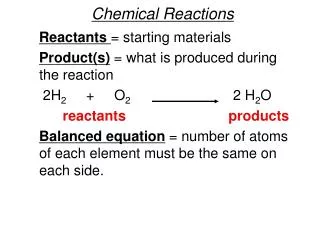
Chemical Reactions 8.5E Investigate how evidence of chemical reactions indicates that new substances with different properties are formed.
How is a chemical change different from a physical change? • Matter can be changed in many ways, but all of these changes can be classified as either a chemical change or physical change.
What is a chemical reaction? • A change in matter that results in a new substance with different chemical and physical properties than the original substance. • Identify the chemical changes: • Glass breaking • Rusting metal • Burning toast • Cutting grass • Fireworks exploding • Melting butter • Digesting food ✓ ✓ ✓ ✓
What are the signs that a chemical reaction has occurred? The best way to identify that a chemical reaction has occurred is the formation of a new substance with different properties. Here are some clues: • Color Change • Gas Production • Change in Energy • Precipitate formation
When does color change indicate that a chemical reaction has occurred? • When a color change is unexpected. For example, you would expect to get a green liquid when you mix a blue and yellow liquid. But getting a green liquid from combining two clear liquids is unexpected. • Examples of chemical reactions that result in color change: • Bleaching clothes • Dying hair • Burning toast
What are some examples of gas production during a chemical reaction? • Bubbles, fizzing, foaming, releasing a vapor (not boiling) • Burning wood – the smoke is a new product made of carbon dioxide and water vapor. • Combining vinegar and baking soda – bubbles and fizzing releasing carbon dioxide gas
What does “a change in energy mean?” • A change in energy in a chemical reaction means that energy is either absorbed or released during a chemical reaction. • It is very common for energy in the form of heat (thermal energy) to be absorbed or released during a chemical reaction. This results in either a temperature increase or decrease. • Sometimes the change in energy is light energy being absorbed or released. Photosynthesis is an example of a reaction that absorbs light energy. A glow stick is an example of a chemical reaction releasing light energy.
What is a precipitate? • A precipitate is a solid that forms during a chemical reaction between two liquids.
Most Importantly…. • Always ask “Is it a new substance with different properties?”