ECONOMICS
This comprehensive guide covers the foundational concepts of economics including human wants vs. scarce goods, opportunity cost, and the rational behavior of consumers and firms. It explores microeconomics and macroeconomics, the principles of supply and demand, and the significance of comparative advantage and Pareto efficiency. Key economic theories such as elasticity, market equilibrium, and the roles of firms in understanding costs and profits are elaborated. By grasping these concepts, individuals can better understand economic decision-making and its impact on society.

ECONOMICS
E N D
Presentation Transcript
ECONOMICS CRUNCH KIT
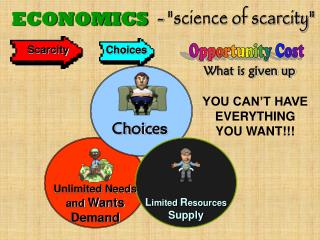
BASICS OF ECONOMICS • § Human wants are unlimited, but goods are scarce • § There are no free lunches; you can never get something truly free (due to the cost of time, and other costs) • § To get one thing, we must give up another • § Humans behave rationally in economics • § The full cost of an action includes its opportunity cost • § Opportunity cost: value of the next-best alternative
RATIONALITY • § Marginal cost: cost of producing/consuming ‘‘one more’’ • § Marginal benefit: benefit of producing/consuming ‘‘one more’’ • § Rational agents will produce or consume a good until marginal cost = marginal benefit/revenue (MC = MR) • § Rational consumers maximize their utility, or satisfaction; rational firms maximize their profits
POSITIVE VS. NORMATIVE • § Positive: ‘‘What is’’ (taxes are 20%) • § Normative: ‘‘What should be’’ (taxes should be lower)
MICRO VS. MACRO • § Microeconomics: focuses on individual decision making; works its way up from individuals to markets to economies • § Macroeconomics: focuses on the economy as a whole; tracks economy wide variables; takes a top-down approach
COMPARATIVE ADVANTAGE • § Comparative advantage: being able to produce a good at a lower opportunity cost than anyone else • § Absolute advantage: being able to produce a good more • efficiently than everyone else • § An individual can have an absolute advantage in everything, but NOT a comparative advantage in everything • § Agents should specialize in what they have a comparative advantage for, and then everyone will benefit from trade
THE PRODUCTION POSSIBILITIES FRONTIER (PPF) • A PPF shows all of the ways an economy can produce goods • § Each axis features a good; the PPF measure trade-offs between these two goods • § All points outside the curve are impossible to produce at • § Points inside the curve are possible but inefficient and do not use all available resources
PARETO EFFICIENCY • Something is Pareto efficient if it is impossible to improve well-being without hurting someone else • § Pareto efficiency provides no way to judge the superiority of one distribution versus another
PERFECTLY COMPETITIVE MARKETS • § The good being sold must be highly standardized • § Large number of buyers and sellers • § Everyone is well informed about the market price • § No barriers to entry exist; new firms enter easily • § Everyone is a price taker
DEMAND • § Law of demand: the quantity demanded of a good decreases when the price increases and vice versa • § Demand: this relationship between prices and quantities for a particular market • § Quantity demanded: the amount demanded at a given price • § Demand can shift due to consumer income, substitutes and complements, the number of consumers, and consumer preferences and expectations
SUPPLY • § Law of supply: the quantity supplied of a good increases when the price increases and vice versa • § Supply: relationship between prices and quantities for a particular market • § Quantity supplied: the amount supplied at a given price • § Supply can shift due to changes in factor costs, technology, expectations of future prices, number of producers, and government regulations
ELASTICITY • § Percent change in quantity over percentage change in price • § Price elastic demand: goods with close substitutes, luxuries • § Price inelastic demand: necessities • § Price elastic supply: long run • § Price inelastic supply: short run, scarce good • § Factors affecting demand elasticity: substitutes, necessities, scope of market, time horizon • § Factors affecting supply elasticity: scarcity of inputs, presence of barriers to entry, time horizon
MICROECONOMIC EQUILIBRIUM • § Equilibrium: intersection of supply and demand • § Consumer surplus: difference between how much consumers are willing to pay and the market price • § Producer surplus: difference between the price at which firms are willing to sell and the market price • § Market equilibrium maximizes consumer and producer
THREE FUNDAMENTAL QUESTIONS OF ECONOMICS • How much should be produced? • Who should produce the good? • Who should receive the good?
ECONOMIC AND ACCOUNTING PROFIT • § Total revenue: amount a firm receives from selling its goods • § Total cost: costs of a firm supplying its goods • § Accounting cost: actual monetary cost • § Accounting profit: straight monetary profit earned • § Economic cost: both monetary (accounting) cost and the opportunity cost of the resources used • § Economic profit: monetary profit minus opportunity cost; always equal to zero in the long run
FIRMS AND COSTS • § Fixed costs: costs that a firm must pay regardless of how • much it produces (rent, utilities); only fixed in short run • § Variable costs: costs that change with the amount produced • § Average cost: the sum of fixed costs and total variable costs, divided by the total number of units produced • § After a certain point, marginal costs stop decreasing and begin increasing-----this is called diminishing returns to scale • § In the long run, all costs are variable
PRICE CONTROLS • § Price ceilings set a maximum; price floors set a minimum • § Deadweight loss: lost efficiency due the market not being in equilibrium • § Binding price controls ALWAYS have deadweight losses • § Price controls transfer surplus from consumers to producers or vice versa • § Taxes distort the market, transferring surplus from the market to the government at the expense of efficiency • § The more inelastic party always bears more of the tax • § Revenue equals price times quantity
MARKET FAILURES • § A market failure is when competitive markets fail to produce socially desirable outcomes • § Two types discussed here are externalities and public goods
EXTERNALITIES • § Externalities are costs or benefits that affect a third party uninvolved in the activity or transaction in question • § Individuals do not factor externalities into their decisions since they do not pay the costs or reap the rewards • § Negative externalities harm third parties; the tendency is to overproduce them • § Positive externalities benefit third parties; there are not enough of them
PROPERTY • § Coase Theorem: private parties can resolve the inefficiencies created by externalities as long as property rights are clearly defined and all parties can negotiate with each other • § A rival good, when it is consumed, can no longer be consumed by anyone else • § People have limited access to excludable goods • § Private goods are both rival and excludable • § Public goods are neither • § Collective goods are non-rival and excludable • § Common resources are non-excludable and rival • § The tragedy of the commons occurs when people overuse a resource because no one owns it
MARKET POWER • § A firm with a downward sloping demand curve has market power; they can choose their price • § The combinations of price and quantity available to choose from are determined by the market demand
MONOPOLY • § Market with only one firm • § Produce less than what consumers demand, and sell it at higher than the market price; results in contrived scarcity • § Arise due to the presence of barriers to entry • § Price discrimination: charging different customers different prices; a monopoly can capture more of the consumer surplus for the firm
OLIGOPOLY • § Market with only a few firms • § Collusion: when firms cooperate to artificially raise market prices by restricting supply • § Cartel: group of firms that collude • § Cartels often break up due to an incentive to cheat
MONOPOLISTIC COMPETITION • § Firms compete through product differentiation, not price competition • § Few barriers to entry exist • “BRAND” MONOPOLY, but not product monopoly
INSTITUTIONS, ORGANIZATIONS, AND GOVERNMENT • § Institutions: formal or informal rules that guide human interactions • § Organizations are like institutions but more formal • § Governments can tax their citizens and use force • § Pork barrel politics: elected officials tend to steer money to their constituents by introducing projects • § Logrolling: vote trading among elected officials • § Rent seeking: socially unproductive activities that simply direct economic benefits
GROSS DOMESTIC PRODUCT (GDP) • § Market value of all final goods and services produced within a country in a given period of time; four components • § GDP = Y = C + I + G + NX • § Consumption: consumer spending on final goods • § Investment: value of all money spent on capital or technology • § Government expenditures • § Net exports: exports minus imports • § Business cycle: fluctuations in GDP over recessions and expansions • § Average labor productivity: GDP divided by the total number of workers employed
MACROECONOMIC MODELLING • § Circular flow model: households own factors of production; firms rent factors and produce goods, which households buy; two markets: goods market and factor market • § Aggregate demand (AD): quantity of goods demanded by an economy at different price levels, slopes downward • § Aggregate supply (AS): potential supply of goods and services in an economy at different price levels • § Short run aggregate supply (SRAS): slopes upwards • § Long run aggregate supply (LRAS); fixed at full employment output; vertical line; independent of price level • § Short run equilibrium: intersection of SRAS and AD; long run equilibrium is at the intersection of all three curves
UNEMPLOYMENT • § Labor force: all individuals 16 or over, not in prison or armed forces, and actively looking for work or has a job • § Employment rate: percentage of labor force with a job • § Participation rate: percentage of population in the labor force • § Structural unemployment: unemployment due to large shifts in economy; mismatch between skills demanded and skills supplied • § Cyclical unemployment: caused by the business cycle • § Frictional unemployment: natural unemployment due to timelag between jobs • § Unemployment rate calculated every month by the BLS • § Natural rate of unemployment: never 100%; structural + frictional unemployment • § Okun’s Law: for every 1% increase in unemployment, GDP drops by 2%
MONEY • § A medium of exchange, unit of account, and store of value • § Commodity money: money with intrinsic value • § Fiat money: intrinsically worthless; declared valuable by gov’t • § Inflation: rise in price level; decrease in purchasing power of money; measured by the CPI and GDP deflator • § Liquidity: how easily an asset can be converted into currency
THE FINANCIAL SYSTEM • § Savings: income that is not spent • § Investment: purchase of new capital equipment • § Bond: a certificate of indebtedness • § Stock: ownership of a portion of a company • § Net capital outflow: domestic purchase of foreign capital minus foreign purchase of domestic assets
FISCAL POLICY • § Government spending or taxes to influence AD • § Contractionary: increasing taxes, decreasing spending • § Expansionary: decreasing taxes, increasing spending
MONETARY POLICY • § Open market operations: buying or selling securities, done by the FOMC • § Reserve ratio: fraction of deposits banks must keep in reserve; adjusted by Board of Governors • § Discount rate: interest rate the Fed charges to member banks; adjusted by Board of Governors • § Contractionary: selling securities, increasing reserve ratio, increasing discount rate • § Expansionary: buying securities, decreasing reserve ratio, decreasing discount rate • § Quantity theory of money: MV = PY or MV = PQ
THE ECONOMICS OF RUSSIA • § Russia transformed into a planned economy after the Russian Civil War • § The Soviet Union, an economic union of 15 nations, operated under strict bureaucratic planning • § Flawed planning mechanisms caused chronic shortage • § Mikhail Gorbachev launched perestroika, restructuring of the communist system, but worsened the economy • § Gorbachev was ousted and the Soviet Union collapsed in 1991 • § Boris Yeltsin, Russia’s first elected president, successfully privatized most of the economy • § Vladimir Putin entered office as global oil prices rose and the Russian economy prospered • § Dmitri Medvedev entered office shortly before the 2008 global financial crisis • § He pursued ‘‘modernization’’ efforts
Economists • Michael Boskin • In 1996, assigned to head a committee to review the methods used to calculate CPI • Michael Edelstein • Constructed the ‘‘marginal’’ and ‘‘strong’’ set of standards to gauge the effect of empire ion the British economy • Stanley Engerman • Estimated profitability of the slave trade • Milton Friedman • Most famous advocate of monetary policy (instead of Kenyesian policy)
John Maynard Keynes • Proposed fiscal policy as a way to smooth out the business cycle; his theories put to the test in the Great Depression; wrote 1936 book • The General Theory of Employment, Interest, and Money • Simon Kuznets • Commissioned by the U.S. Department of Commerce to develop a system to measure national output • Joseph Schumpeter • Described the impact of entrepreneurs as ‘‘creative destruction’’ • Adam Smith • Father of classical economics; wrote the 1776 book • An Inquiry into the Nature and Causes of the Wealth of Nations
Okun, Arthur • One of President Kennedy’s chief economic advisors in the early 1960s; articulated OKUN’S LAW • Every 1% that the unemployment rate is off from the natural rate of unemployment, the output gap deviated by 2% • Pareto, Vilfredo • Italian economist (1848-1923); first came up with the concept that an outcome was efficient only if there was no way to improve someone’s well-being without reducing someone else’s well-being
COMMENTARY: • Aslund, Anders • Two-thirds of national employment must be private • Colton, Tim • Bureaucratic planners were unable to anticipate the need for computerization • Gontmakher, Evgeny • Russia’s economic woes are ‘‘a result of incorrect economy policy, oil dependence, and rampant corruption.’’ • Hanson, Philip • Noted that rising global prices of oil and gas indirectly fueled Russian economic growth (with negative consequences) • Kornai, Janos • The distinction between national and regional firms in the Soviet Union was meaningless: ‘‘Servility and a heads down mentality prevailed’’
RUSSIANS • Gaidar, Yegor • Primary author of the “shock therapy” reform enacted by Boris Yeltsin, acting prime minister of Russia under Yeltsin • Gontmakher, Evgeny • Analyst; commented on Russia’s experience with the resource curse. He stated, “This is all a result of incorrect economic policy, oil dependence, and rampant corruption, Until the system changes, these problems will persist.”
Shatalin, Stanislavand GrigoryYavlinsky • Economists and Gorbachev advisors; helped produce the 500 Day Plan • Chubias, Anatoly • economist; Yeltsin’s first privatization czar; started the program • Polevanov, Vladimir • Russia’s Minister of Privatization during Boris Yeltsin’s presidency who halted Yeltsin’s second stage of privatization, advocated renationalization of some firms
PERCENTAGES -20% to 10% • -17% • (111) Percent growth of the Soviet Union’s GDP by the time of its collapse in 1991 • -0.2% • (119) Percent growth of Russia’s GDP in 2009 • 2% • (118) Percent growth of Russia’s oil production in 2007 • 3% • (111, 118) Percent growth of Russia’s GDP in 1989 • Percent growth of Russia’s oil production in 2006 • 5% • (118) Percent growth in Russia’s oil production in 2005
PERCENTAGES -10% to 10% • 6% • (119) Russia’s unemployment rate in 2008 • 9.7% • (72) The United States’ unemployment rate in August 2009 • 10% • (110, 118, 119) • Yearly percent decline in Russia’s production between 1989 and 1991 • Percent growth in Russia’s oil production in 2004 • Increase in Russia’s real disposable income between 1999 and 2008
10% - 25% • 12% • Russia’s unemployment rate in 1999 • Percent of Russians living on subsistence minimum in 2008 • 13% • Flat income tax rate imposed by Vladimir Putin during his first term (2000-2004) • 16% • (86, 119) Decline in the United States’ CPI from 1920 to 1922 • Percent decline in Russia’s industrial output between October 2008 and February 2009, according to Bank of America Securities-Merrill Lynch
10% - 25% • 19% • (118) Percent of Russia’s oil coming from state-owned firms in 2004 • 20% • (114) Average percent of shares sold by each firm during Boris Yeltsin’s voucher program • 24% • (117) Russia’s tax rate on profits after Vladimir Putin’s tax cuts • 25% • (86, 114) Decline in the CPI from 1929 to 1933 • Percent of insider ownership allowed under Boris Yeltsin’s voucher program
25% - 50% • 28% • (119) Decline in Russian government revenue by the first quarter of 2009 • 29% • (114) Percent of shares that had to be sold during the voucher program under Boris Yeltsin’s decree • 35% • (117) Russia’s tax rate on profits before Vladimir Putin’s tax cuts • 41% • (119) Percent of Russians living at subsistence minimum in 1999 • 50% • (118) Percent of Russia’s oil coming from state-owned firms in 2008
50% - 215% • 66% • (72) The United States’ current labor force participation rate • 70% • (119) Percent decline in the value of Russia’s stock market between June 2008 and January 209 • 75% • (115) Percent of Russia’s large and mid-sized firms privatized by 1996 • 90% • (115) Percent of Russia’s industrial output privatized by 1996
50% - 215% • 99% • (107) The Soviet Union’s literacy rate at the time of its collapse • 100% • (111) The Soviet Union’s inflation rate at the end of 1991 Economics Power Guide | 134 • 245% • (112) Average percent increase in prices the day after Boris Yeltsin freed prices on January 2, 1992
FISCAL & MONETARY POLICY TERMS • Contractionary policy • Policy meant to fight inflation and decrease aggregate demand • Discount rate • Interest rate the Federal Reserve charges for loans to its member banks • Expansionary policy • Policy meant to fight recession and increase aggregate demand • Federal funds rate • Interest rates banks charge on loans to each other; based on the discount rate but not set by the Federal Reserve
FISCAL & MONETARY POLICY TERMS • Fiscal policy • Government taxation and spending policy choices meant to influence the economy • Monetary policy • Policies set by a central bank (for us, the Federal Reserve) to accelerate or slow down the economy by increasing or decreasing the money supply, respectively • Open market operations • The trading of government securities by the Federal Reserve to adjust the size of the money supply • Reserve ratio • The amount of each deposit banks must hold in reserve
FORMULAS • Average Total Costs • Total fixed costs + total variable costs total number of units produced • CPI • Basket price in year t x 100 basket price in base yr • GDP Deflator • Nominal GDP x 100 Real GDP
FORMULAS • GDP • C + I + G + X • General Profit Maximizing Condition • MR = MC • Money Multiplier • 1 RR