Download
1 / 69
710 likes | 861 Vues
This overview delves into the biology of heme and porphyrins, cyclic compounds vital for various physiological processes. Heme, the predominant metalloporphyrin in humans, plays a crucial role in oxygen transport and signaling, while porphyrins are key in solar energy utilization and enzymatic processes. The lecture outlines heme synthesis, regulation, and degradation, as well as iron metabolism and associated disorders, including porphyrias and anemia. Understanding these components can illuminate their significance in health and disease.

E N D
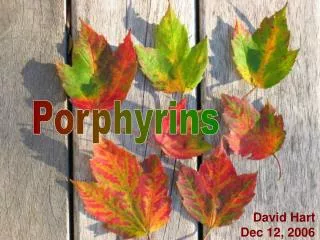
Porphyrins David Hart Dec 12, 2006
Porphyrins • Cyclic compounds that bind metal ions • Chlorphyll (Mg2+) • Central to solar energy utilization • Heme (Fe2+) • Most prevalent metalloporphyrin in humans • Central to oxygen sensing and utilization • Cobalamin (Cobalt) Bacterial Coenzyme F430 (Nickel)
Heme • One ferrous (Fe2+) atom in the center of the tetrapyrrole ring of ProtoporphyrinIX • Prosthetic group for • Hemoglobin and Myoglobin • The Cytochromes • Catalase and Tryptophan pyrrolase • Nitric Oxide Synthase • Turnover of Hemeproteins (Hemoglobin, etc) is coordinated with synthesis and degradation of porphyrins • Bound iron is recycled
Lecture Outline • Heme function • Heme synthesis and regulation • Iron metabolism • Porphyrias • Heme degradation
Heme Function • Oxygen sensing (heme and hemoproteins) • Oxygen transport (hemoglobin) • Oxygen storage (myoglobin) • Electron transport (cytochromes) • Oxidation (cyrochrome p450, tryptophan pyrrolase, guanylate cyclase …) • Decomposition and activation of H2O2 (catalase and peroxidase) • Nitric Oxide Synthesis • Regulation of cellular processes • Effector of apoptosis
Porphyrin: Cyclic molecule formed by linkage of four pyrrole rings through methenyl bridges B A N HN NH N C D
Porphyrin Side Chains • M = Methyl (-CH3) • V = Vinyl (-CH=CH2) • P = Propionyl (-CH2-CH2-COO-) • A = Acetyl (-CH2-COO-)
Biosynthesis of Heme • Synthesized in every human cell • Liver (15%): • 65% Cytochrome P450 • Synthesis fluctuates greatly • Alterations in cellular heme pool • Bone Marrow (80%) • Erythrocyte precursors: Hemoglobin • Synthesis relatively constant • Matched to rate of globin synthesis • Largely unaffected by other factors
All Carbon and Nitrogen atoms provided by 2 building blocks: COOH CH2 CH2 COSCoA SUCCINYL CoA CH2 NH2 COOH GLYCINE
COOH CH2 CH2 COSCoA SUCCINYL CoA CH2 NH2 COOH GLYCINE is Decarboxylated - CO2 AMINOLEVULINIC ACID SYNTHASE IN MITOCHONDRIA
COOH CH2 CH2 C=O CH2 NH2 Condense to form: AMINOLEVULINIC ACID (ALA) MOVES OUT OF THE MITOCHONDRION
COOH CH2 CH2 C=O COOH CH2 CH2 C=O -2 H2O CH2 NH2 CH2 NH2 2 Molecules dehydrated by • ALA DEHYDRATASE
COOH CH2 CH2 C COOH CH2 C C C NH CH2 NH2 To form Porphobilinogen (PBG)
COOH CH2 CH2 Acetate CH2COO- Propionate CH2CH2COO- COOH CH2 N H CH2 NH2 Porphobilinogen (PBG)
A P N H CH2 NH2 Porphobilinogen (PBG)
A A A A P P P P N H N H N H N H CH2 NH2 CH2 NH2 CH2 NH2 CH2 NH2
Hydroxymethylbilane synthase& Uroporphyrinogen III synthase • Four PBG molecules condense • Ring closure • Isomerization
P A B A A P NH HN Uroporphyrinogen III NH HN A C D A P P
COOH CH2 CH2 COOH CH2 -CH2-CH2-COOH HOOC-H2C- NH HN Uroporphyrinogen III NH HN -CH2-COOH HOOC-H2C- CH2 CH2 COOH CH2 CH2 COOH
Series of decarboxylations & oxidations • Porphyrinogens: • Chemically reduced • Colorless intermediates • Porphyrins: • Intensely colored • Fluorescent • Uroporphyrinogen III • Coproporphyrinogen III Moves back into Mitochondrion • Protoporphyrinogen IX • Protoporphyrin IX
CH=CH2 CH3 -CH=CH2 H3C- NH N Protoporphyrin IX N HN -CH3 H3C- CH2 CH2 COOH CH2 CH2 COOH
HEME Fe2+ chelated by Protoporphyrin IX Assisted by Ferrochelatase CH3-
AMINOLEVULINIC ACID SYNTHASE • Two tissue-specific isozymes • Coded on separate genes • InLiver, heme represses synthesis and activity of ALAS • Heme can be used for treatment of acute porphyric attack • In RBC heme synthesis regulation is more complex • Coordinated with globin synthesis
IN MITOCHONDRIA COOH CH2 CH2 COSCoA COOH CH2 CH2 C=O SUCCINYL CoA ALA CH2 NH2 COOH CH2 NH2 GLYCINE • AMINOLEVULINIC ACID SYNTHASE RATE-CONTROLLING STEP IN HEPATIC HEME SYNTHESIS
Bonkovsky ASH Education Book December 2005
Disorders of Heme Synthesis • X-linked Sideroblastic Anemia • Lead Poisoning • Iron Deficiency Anemia • The Porphyrias
X-linked Sideroblastic Anemia ALAS Requires Pyridoxal Phosphate as Coenzyme Some Sideroblastic Anemias improve with Pyridoxine (B6)
ALA moves out of the mitochondrion COOH CH2 CH2 C=O COOH CH2 CH2 C=O A P -2 H2O N H CH2 NH2 CH2 NH2 PBG CH2 NH2 • ALA DEHYDRATASE Inhibited by Heavy Metal: LEAD POISONING
Lead Poisoning Lead Poisoning ALAD and Ferrochelatase Are particularly sensitive to Lead inhibition Ferrochelatase Heme Fe + PPIX
Iron Metabolism • Reactive Transition Metal (Fe2+ Fe3+) • Normally present complexed with proteins that limit its reactivity • Both iron deficiency and iron overload cause cellular defects and disease • Most available iron generated by macrophages that recycle red cell iron • Dietary Fe3+ in duodenum converted to Fe2+ and absorbed by duodenal enterocyte
Iron 35% of Earth’s mass nasa
Hepatocyte Macrophage Erythroid Cell Blood Apical Duodenal Enterocyte GUT Contents Fe3+ Heme diFe3+ Transferrin Fe2+ Fe2+ Mitochondrial Heme Synthesis
NEJM June 2004
Blood Macrophage RBC Hemoglobin Haptoglobin Heme Hemopexin Fe2+ Fe2+
? Syed, Hemoglobin 2006
Hentze, Muckenthaler & Andrews Cell, Vol 117, 285-297, April 30, 2004 Hepcidin
Hepcidin: 25 Amino Acids J Med Genet 2004
Beutler, Science Dec 2004
Hentze, Muckenthaler & Andrews Cell, Vol 117, 285-297, April 30, 2004 Ferroportin
Genetic HemochromatosisDisruption of Hepcidin / Ferroportin • Autosomal Recessive • HFE C282Y/C282Y • TfR2 • Hemojuvelin • Hepcidin • Autosomal Dominant • Ferroportin
Normal Liver medlib.med.utah.edu
Granular, Dark Reddish Brown Surface of Liver in Hemochromatosis www.med.niigata-u.ac.j
Iron Accumulation in Chronic Disease http://eduserv.hscer.washington.edu