Discovering Our Sun: Size, Structure, and Its Impact on Earth
140 likes | 288 Vues
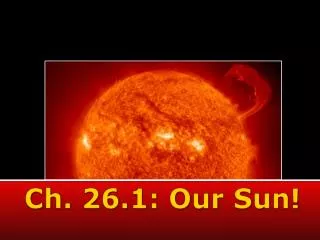
The Sun, a massive star, contains 99% of the solar system’s mass and has a diameter of 1,400,000 km. It is 150 million km away from Earth on average, with light reaching us in about 8.5 minutes. The Sun generates energy through hydrogen fusion, creating intense heat and plasma. Its atmosphere consists of several layers: the photosphere, chromosphere, and corona, featuring phenomena like sunspots, solar flares, and solar wind. These phenomena influence Earth, causing beautiful auroras and sometimes disrupting technology.


Discovering Our Sun: Size, Structure, and Its Impact on Earth
E N D
Presentation Transcript
Size • 1,000,000 Earths could fit inside • contains 99% of the solar system’s mass • Diameter of 1,400,000 km • If the sun were the size of a bottle cap, the largest known star would be the size of a football field!
Distance • 150,000,000 km away from Earth (average) = 1 Astronomical Unit (AU) • 93,000,000 miles • Light, traveling at 300,000 km/s takes 8.5 minutes to reach Earth
Energy • Fusion of hydrogen (H2) into helium (He) gives sun it’s energy • 4 H2 atoms = 1 He atom + energy • Intense heat and pressure causes these atoms to exist in the form of plasma
Layers • The sun’s temperature decreases from core to surface • From the surface of the sun to the outer atmosphere, the temperature increases • The sun’s layers are heated by convection
Layers (cont.) Sun Sun’s Atmosphere
Photosphere (layer 4) • surface of the sun • contains features such as sunspots and granules
Granules • bubbles of hot gas visible on the surface of the sun • 1,000 km in diameter • last about 20 minutes
Sunspots • dark spots on surface of sun • cooler than surrounding surface • result from complications in sun’s magnetic field • sunspots go from a min to a max and back to min in 11 year cycles
Solar Flares • sudden bursts of energy from the photosphere through the outer atmosphere • rise up suddenly in areas of sunspot activity • number of solar flares increases with the number of sunspots
Chromosphere (layer 5) • inner layer of atmosphere • thousands of km’s off of surface • contain solar prominences dense clouds of plasma suspended over surface by magnetic fields
Corona (layer 6) • thin outer atmosphere • 1,000,000 times less bright than photosphere • only visible during solar eclipse • responsible for solar wind
Solar Wind • constant stream of electrically charged particles from corona • fly in all directions from sun at 450 km/s • takes 2-3 days to reach Earth • solar flares & wind create auroras on Earth • particles interact with Earth’s magnetic field • Northern and Southern lights
Magnetic Storms • occur when solar flares are added to constant solar wind • auroras may be visible at mid-latitudes • electrical surges may disrupt cell phone service & damage electrical appliances