Exploring the Cosmic Ray Sources & Neutrino Signatures with IceCube Detector
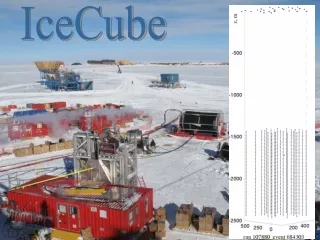
Delve into the intricacies of cosmic rays and high-energy neutrinos using data from the IceCube Detector. Learn about particle acceleration, neutrino production, and the detection of neutrino signatures. Discover the latest findings on astrophysical neutrinos and cosmic ray observations. Stay informed on the search for point sources in the northern and southern skies. Unravel the mysteries of the universe through the lens of IceCube's high-energy physics research.

Exploring the Cosmic Ray Sources & Neutrino Signatures with IceCube Detector
E N D
Presentation Transcript
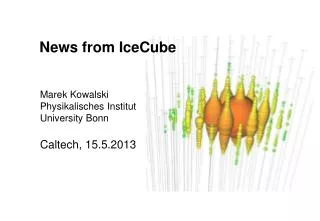
News from IceCube MarekKowalski PhysikalischesInstitutUniversity BonnCaltech, 15.5.2013
Cosmic Rays • Cosmic rays have been observed up to 1020eV! • What are the sources? • How are particles accelerated? High-energy neutrinos can be important messenger particles. Spectrum of charged particles LHC
Neutrino production in cosmic sources p p 0 e Inverse Compton (+Bremsstr.) Fermi shock acceleration of protons: dN/dE~E-2 radiation fields and matter protons/nuclei electrons/positrons
Neutrino propagation Neutrino propagation Protonen AGN Neutrinos g - Radiation Neutrino oscillation length: l23 1011 (En/TeV)cm p + X+- + 0 + ... n + m + ... Flavor ratio at the source ne : nm : nt 1 : 2 : 0 Flavor ratio at the Earth: ne : nm : nt 1 : 1 : 1
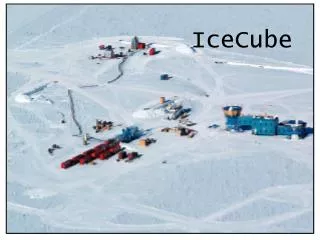
The IceCube Detector Digital Optical Module
The IceCube Detector Installation
The IceCube Detector Installation
Effective scattering coefficient l-1 [1/m] IceCube Coll, J. Geophys. Res. 111 (2006) D13203 Optical properties of the detection medium
The IceCube Detector IceCubewith86 strings IC79
Neutrino signatures signature of Muon-tracks + good pointing (~1 degree) + large event rates due long muon range 6 PeV 10 TeV
Neutrino signatures signature of signature of e • Particle shower (cascade) • +ne,nt ,(nm ) • + good energy resolution (~0.2 in logE) + little background +N+... ± (300 m track!) +hadrons 375 TeV Multi-PeV
proton „atmospheric“ muon „atmospheric“ Neutrino proton
Observation of moon shadow IceCube Pointing 0.5o Cosmic-ray protons Cosmic rays blocked by the moon lead to a point-like deficit in down-going muons
Astrophysical neutrino search Point source
Point Source Search: IceCube 40 & 59 Search for point sources Northern sky & Southern sky
Point Source Search: IceCube 40 & 59 Search for point sources Northern sky & Southern sky Hottest spot: Post-trial p-value: ~67% No evidence for neutrino sources, yet
Astrophysical neutrino search Sum of all point sources = isotropic/diffuse flux
Diffuse flux Atmospheric Neutrinos primary cosmicray airshower D π K μ μ e νe νe νμ Waxman & Bahcallbound on astrophysicalneutrinos νμ prompt atmo. ν conventional atmo. ν
Search forneutrino-inducedcascades, i.e. νe&ντ IC40 results: Events >100 TeV • 3 eventsobserved • 0.35 expected2.4 σ 220 TeV
Next: pushingthe high energyfrontier
Search for UHE neutrinosin IceCube (IC86) Diffuse flux Simple searchforultra high energyneutrino eventsbycut on # photoelectrons (NPE) cos(zenith angle) cos(zenith angle) Ernie (1.1±0.4) PeV Bert (1.3±0.5) PeV 670 daysofIC86 submittedto PRL
Search for UHE neutrinosin IceCube (IC86) Diffuse flux Ernie (1.14 ± 0.14) PeV Bert (1.04 ± 0.14) PeV 2.8 σexcessoverbackgroundofatmosphericmuonsandneutrinos
Search for UHE neutrinosin IceCube (IC86) Diffuse flux Ernie (1.14 ± 0.14) PeV Bert (1.04 ± 0.14) PeV 2.8 σexcessoverbackgroundofatmosphericmuonsandneutrinos
Vetoingatmosphericmuonsandneutrinos primary cosmicray airshower Downgoingeventwithout Airshowerastro. neutrino! D π K μ e νe νe νμ μ νμ
High EnergyStarting Event Search - Results Expectadbackground: 12.1 ±3.4
Event Distribution in theDetector Preliminary
EnergyvsDeclinationofContained Vertex Events inconsistentwithbackground @ 4.3σ (includingdirectionandenergy)
EnergySpectrum Harder thanatm. Background; potenticalcut-off at ~2 PeV
Whatareweobserving? • Increasing evidence for high-energy component beyond the atmospheric spectrum (now 4.3 σ) • Hard spectral component might have a cut-off • Neutrino flavor ratio consistent with 1:1:1 • Directions consistent with being diffuse flux • Publication and more data coming soon