Explore Antarctic Research: Uncovering Ocean Ecosystems and Climate Effects
Join scientists Elizabeth Leonardis and L. Alex Kahl at Palmer Station for an extraordinary Antarctic summer of research (2008-2009). Discover the stunning Antarctic Peninsula as they conduct vital studies on phytoplankton and oceanographic properties. Accessible only by a five-day ship journey from Chile, Palmer Station offers comfort and essential facilities for scientific exploration. Utilizing state-of-the-art technology like Autonomous Underwater Vehicles, this research aims to understand ecological changes due to climate warming. Learn more about their findings and ongoing research at their website.

Explore Antarctic Research: Uncovering Ocean Ecosystems and Climate Effects
E N D
Presentation Transcript
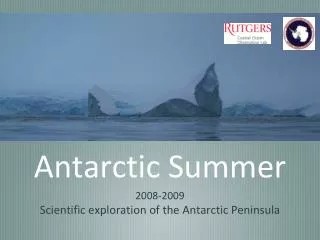
Antarctic Summer • 2008-2009 • Scientific exploration of the Antarctic Peninsula
Elizabeth Leonardis age: 28 years old from: New York City undergrad: UC Santa Barbara grad: starting Fall 2009 profession: Nurse/Lab Technician • L. Alex Kahl • age: 29 years old • from: New York City • undergrad: UC Santa Barbara • grad: Rutgers University • profession: Oceanographer
Palmer Station • The U.S. research station where we will be living and conducting research for the next 6 months • Accessible only by ship, a 5 day journey from Punta Arenas, Chile • Currently 21 employees and 5 scientists living on station for the summer season • Station has many luxuries including comfortable rooms, a gym, bar and 24hr internet connection
Gym Bar Lounge Bedroom
Using our zodiac “Bruiser”, we travel to stations B & E for collection of: • Phytoplankton samples • bio-optical characteristics (absorption, scattering of light) • physical properties (temperature, salinity) of seawater
Palmer Station B E Boating Map of the Palmer Station Area including our sampling stations B & E
photo: Scott Sternbach photo: Scott Sternbach Using a GPS for precise location we drive our zodiac to each sampling station Go-Flow bottles are lowered using a winch on the zodiac to collect seawater samples at different depths
Bio-optical measurements are taken in the field by lowering a cage equipped with optical instruments that detect light utilized by phytoplankton • Real time data is collected that shows physical and bio-optical properties of the water column photo: Scott Sternbach
Back at the lab...... seawater is filtered for phytoplankton
Samples are then analyzed for: • - total chlorophyll • - pigment composition • - nutrients • - dissolved organic carbon • - flow cytometry • - DNA • - rate of photosynthesis Photo: Scott Sternbach
“Gliders” • Autonomous Underwater Vehicles (AUVs) • Gliders will be deployed from Palmer Station to study the properties of the water column in the Antarctic
Palmer Long-Term Ecological Research (LTER) Study An annual month long research cruise along the Antarctic Peninsula, Jan. 2009 Studying changes in sea ice, phytoplankton, zooplankton, and penguins photo: Nathan Hoople
The LTER is investigating ecosystem changes in response to climate warming and pole ward shifts in the climatic gradient Our focus on the LTER will be the phytoplankton/bio-optics component Gliders will be deployed and programed to follow the LTER research grid
To find out more about our Antarctic research, check out our website http://rucool.rutgers.marine.edu/antarctica feel free to contact us with any questions