Download
1 / 7
80 likes | 195 Vues
Discover the fascinating world of atomic interactions and how they shape the chemistry of life! Engage in a hands-on activity by creating static electricity with a balloon to make water 'dance.' Learn about the different types of chemical bonds, including ionic and covalent, that enable atoms to come together and form stable substances. Explore how atoms strive for stability through valence electrons and share findings in group discussions. Complete guided notes on ionic, covalent, and hydrogen bonds to deepen your understanding of these fundamental concepts in chemistry!

E N D
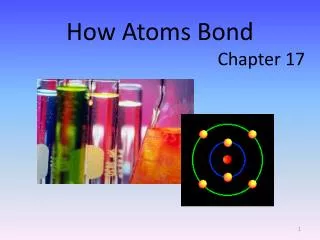
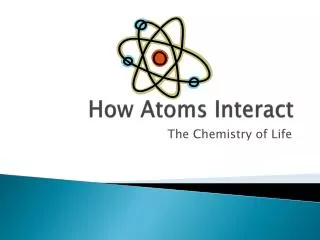
How Atoms Interact The Chemistry of Life
Can you make water dance? • Rub a balloon to create a static charge. • Gently run water out of the faucet. • Hold the balloon next to the stream of water without touching it! (dry with paper towel if needed) • Make the water dance • Sit with your table and discuss how that happens. Jot down your ideas…
Bonding • Atoms join with other atoms to form stable substances. • Atoms want to have a full valence orbital to become stable. • It involves just the v valence electrons.
Guided Notes: • Individually you will be responsible for reading about Ionic Bonds, Covalent Bonds, and Hydrogen Bonds in your textbook (pgs. 29 & 30) • Complete the “Bonding” guided notes. • Once you have completed the notes, take turns going around your table confirming the information.
Covalent Bonds • Occurs between a Nonmetal & Nonmetal • Sharing of electrons • Form Molecules • Ex: CO2, H2O, O2,CH4
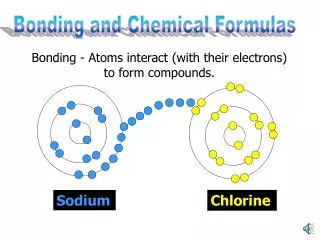
Ionic Bonds • Occurs between a Metal & Nonmetal • Gain or Lose Electrons • Metal gives e- to nonmetal • Ex: NaCl • Chlorine takes e- • Sodium gives e- • Ion: Atoms electrically charged from gaining or losing electrons.