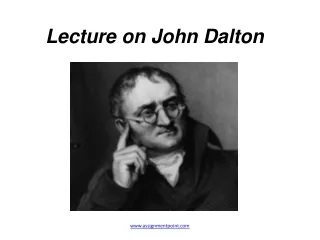
The Legacy of Sir John Dalton: High-Performance Liquid Chromatography and Its Components
100 likes | 275 Vues
This overview explores the contributions of Sir John Dalton and the principles behind high-performance liquid chromatography (HPLC). Dalton's work in atomic theory paved the way for advancements in analytical chemistry. Key components of HPLC include solvent reservoirs, degassers, gradient valves, high-pressure pumps, sample injection loops, and detectors. The importance of precision and accuracy in chromatography is highlighted, along with the voltage requirements for various systems. This resource is essential for understanding HPLC in proteomics and related fields.


The Legacy of Sir John Dalton: High-Performance Liquid Chromatography and Its Components
E N D
Presentation Transcript
Low precision high accuracy High precision low accuracy
High performance liquid chromatography (HPLC) (1) Solvent reservoirs, (2) Solvent degasser, (3) Gradient valve (4) Mixing vessel for delivery of the mobile phase (5) High-pressure pump (6) Switching valve in "inject position” (6') Switching valve in "load position", (7) Sample injection loop (8) Pre-column (guard column) (9) Analytical column (10) Detector (i.e. IR, UV), (11) Data acquisition (12) Waste or fraction collector.
1,000-1,800 volts vs 180V (your wall socket) 220V (euro wall socket) 480V (3rd rail on the metro)
Nano Electrospray Ionization nanoESI From http://www.mrc-mbu.cam.ac.uk/research/proteomics