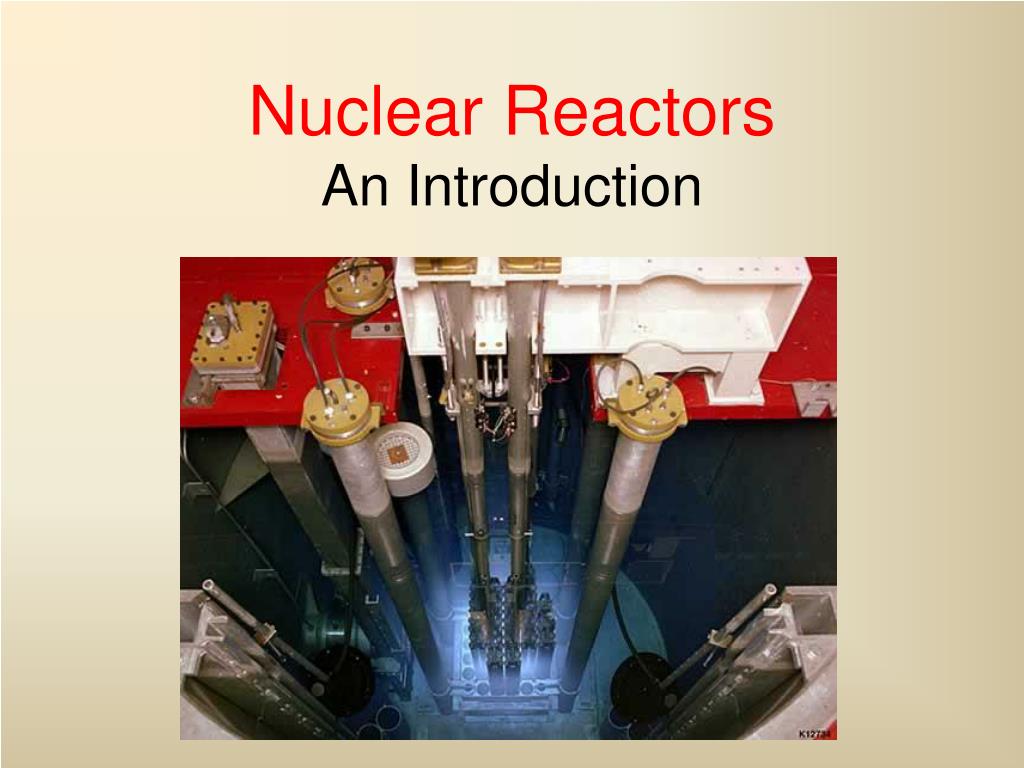
Nuclear Reactors An Introduction. Overview. Nuclear Physics Neutrons, Fission and Criticality Reactor Components Fuel, Moderator and Coolant Types of Nuclear Reactors Generation III and Generation IV Reactors Advantages and Disadvantages of Nuclear Power. The Root of It All: The Atom.
Une image / un lien ci-dessous est fourni (tel quel) pour télécharger la présentation
Politique de téléchargement : le contenu du site vous est fourni TEL QUEL pour votre information et votre usage personnel ; il ne peut être vendu, concédé sous licence ni partagé sur d’autres sites sans l’accord de son auteur.Le contenu vous est fourni TEL QUEL, pour votre information et votre usage personnel uniquement.Téléchargez la présentation en cliquant sur ce lien.Lors du téléchargement, si vous ne parvenez pas à télécharger une présentation, l’éditeur a peut-être supprimé le fichier de son serveur.Pendant le téléchargement, si vous ne parvenez pas à obtenir une présentation, le fichier a peut-être été supprimé par l’éditeur.
Overview • Nuclear Physics • Neutrons, Fission and Criticality • Reactor Components • Fuel, Moderator and Coolant • Types of Nuclear Reactors • Generation III and Generation IV Reactors • Advantages and Disadvantages of Nuclear Power
The Root of It All: The Atom • Protons (p) • mp=1.673 x 10⁻²⁷ kg • charge: +1e • Neutrons (n) • mn=1.675 x 10⁻²⁷ kg • Charge: 0 • Electrons (e) • me=9.109 x 10⁻³¹ kg • Charge:-1e *e is the elementary charge, and it is about 1.602 x 10^-19 Coulomb.
A Nuclear Focus: The Nucleus • The nucleus is comprised of nucleons • Protons • Neutrons Mass number Elemental symbol Atomic number (number of protons) • A=N+Z • N = number of neutrons • gives the total number of nucleons
Isotopes • Nuclei with same number of protons, different number of neutrons • Same Z, different A, thus different N Isotopes of Hydrogen • Similar chemical and physical properties • Very different nuclear properties!
Chart of Nuclides Notice the trend’s digression from the line Z=N, why is this?
Nuclear Glue • There are four fundamental forces: • Gravitational (Universal Law of Gravitation) • Electromagnetic (Coulomb's Law) • Weak nuclear • Strong nuclear • Strong Nuclear Force • Binds the nucleus • Overcomes electromagnetic repulsion between protons • Neutrons (0 charge) facilitate strong interaction • Only acts over small distances, on the magnitude of 10-15 meters!
So back to that trend: • 1:1 ratio of protons to neutrons sufficient for smaller nuclei ~Z≤20 • As nuclei become larger: • Addition of protons increases electromagnetic repulsion • Strong force on the average weakens due to increase in distance • More neutrons are needed then to dilute proton-proton repulsion and increase average strong force! • Largest stable element is an isotope of Lead, Z=82 A=208
Nuclear Binding Energy • Amount of energy required to pull apart a nucleus • Usually expressed as binding energy per nucleon • Greater binding energy per nucleon means a more stable nucleus
Binding Energy The maximum point on the graph occurs around atomic number 56, iron. Thus, iron is the most stable element. Ideally, everything is trying to become iron.
Fission • An exothermic reaction that involves the division of a heavy nucleus into smaller, lighter nuclei. • Utilized in commercial nuclear power
E=mc^2 • Einstein's Theory of Relativity, oh yeah it’s used. • Mass is conserved right? • mass-energy is conserved • Difference in mass between fission reactants and products shows up in the energy produced. • The essence of nuclear power!
Fission • Fission of Uranium 235 is utilized in power production
Extra Neutrons are the key! • Notice the previous reaction started with a neutron and produced three more • Each fission produces ~2-3 neutrons • The product neutrons propagate and can cause other nuclei to fission • This is the key to fission as a power source, it allows for a chain reaction to occur.
Criticality • Critical mass • Amount of fissionable material needed for a sustainable reaction • Three situations • Critical (equilibrium) • Subcritical (exponentially decreases) • Supercritical (exponentially increases)
Criticality These curves show the amount of neutrons present in the three situations. This correlates to the rate of the reaction
Reactor Components • A functional power reactor requires three basic components • Fuel • Moderator • Coolant
Reactor Fuel • All power reactors in the US use Uranium Fuel • This fuel must be enriched before it can be used as fuel
Enrichment • Enrichment is the process of raising the U235 content of natural uranium (U238 is a neutron absorber) • U235 is chemically identical to U238, so how is this done?
Enrichment • Methods include • Centrifuge • Gaseous Diffusion • Atomic Vapor Laser Isotope Separation • What these methods all have in common is that they are very expensive
Moderator • Nuclear fission has a higher probability of occurring when the neutrons involved are at lower velocities • Neutrons are born in fission with velocities of about 30·106 m/s • We would like to slow them down to something closer to 2200 m/s, the velocity of particles in air
Moderator • To do this we use a moderator where the neutrons can bounce around and lose their energy • A good moderator has several properties • High neutron scattering probability • High density • Low Atomic Weight • What might we use as a moderator?
Moderator • The most commonly used moderators are: • Water (H2O) • Graphite (C)
Coolant • Nuclear reactions produce massive amounts of heat (that’s the point!) • We need a way to remove this heat and turn it into electricity
Coolant • Why water coolant? • Cheap • High thermal conductivity • High thermal capacity • We can use it as a moderator at the same time. Brilliant!
How is the reaction controlled? • Control rods: • Control rods are inserted or removed from the reactor to control the reaction rate • The control rods contain large amounts of Boron, a neutron absorber
Reactor Control • In the case of major reactor event, the reactor is scrammed and all the control rods are dropped into the core immediately • SCRAM stands for: Safety Cut Rope Axe Man
Reactor Types American Reactors are Light Water Reactors (LWRs) Coolant: Light Water Moderator: Light Water
What is “light water”? Regular, everyday water Inexpensive, easy to obtain Is there such thing as “heavy water”? Heavy Water: the H atoms in water have an extra neutron Much more expensive Light Water
Light Water Reactors Basic Concept: • Nuclear fission in core generates heat • Heat boils water, creating steam • Steam turns a turbine, which powers a generator • Generator creates electricity Two Types of LWRs: • Boiling Water Reactor (BWR) • Pressurized Water Reactor (PWR)
Pressurized Water Reactor (PWR) • Water kept under high pressure in core (>2000 psi) • Heat transferred to second loop, where the water can boil • Turbine not directly connected to core
Pros: BWR: Less components, simpler system PWR: Fission products contained in reactor vessel Cons: BWR: Containment needed for entire coolant loop PWR: Complex cycle, pressure vessel needed Pros / Cons
CANDU Reactors CANDU = Canadian Deuterium-Uranium Primary Reactor Type used in Canada Moderator: Heavy Water Coolant: Heavy Water Fuel: Natural Uranium
More on CANDUs • Online refueling • CANDU reactors use Natural Uranium as fuel • They get away with this by using Heavy Water as moderator, which has better moderating properties than regular water (higher neutron scattering probibility)
Generation III Nuclear Reactors A generation III reactor design is a enhancement of any of the generation II reactor design incorporating improvements such as improved fuel technology and passive safety systems. The Nuclear Regulatory Commission expects applications for about 24 new plant licenses in the next couple of years These reactors will be Generation III designs
Provide up to 70MW electrical or 300MW heat energy that would satisfy a population of 200,000 people Can be modified as a desalination plant producing 240,000 cubic meters of fresh water Generation III- Russian Floating Nuclear Power Station
Generation IV Nuclear Reactors • The next big thing in Nuclear reactor design (possible deployment in 2030) • Possible designs include: • Very-High-Temperature Reactor (VHTR) • Molten Salt Reactor (MSR) • Sodium-Cooled Fast Reactor (SFR)
utilizes a graphite-moderated Helium cooled core outlet temperature of 1,000 °C. high temperatures enables hydrogen production and allows for high thermal efficiency Generation IV: Very-High-Temperature Reactor (VHTR)
the coolant is a molten salt (why?) nuclear fuel is dissolved in the molten fluoride salt as uranium tetrafluoride (UF4), the fluid would reach criticality by flowing into a graphite core which serves as the moderator Generation IV: Molten Salt Reactor (MSR)