
Motion, Acceleration, and Forces: Understanding Distance, Speed, Velocity, and Friction
E N D
Presentation Transcript
Motion, Acceleration, and Forces Physical Science 2012-2013
MotionSection 3-1 • Motion is a change in position of an object
Distance • The total length of the path an object follows:
Displacement • The distance and direction of an objects final position from its initial position • Displacement includes both a length/size and direction and is called a vector
Speed • The distance an object travels per unit time. • We use metric (SI) units and it is meters per second (m/s) • Usually the speed of an object changes as it moves from one place to another
Instantaneous Speed • The speed of an object at a single point in time • Speedometer
Average Speed • The total distance traveled divided by the total travel time ___ V = d/t ____ V = average speed d=distance t=time
Practice Problems • What is the average speed of a car that travels a distance of 750m in 25s ? • What is the average speed of a motorcycle that travels a distance of 300m in 10s ? • What is the average speed of an airplane traveling a distance of 1000m in 10s ?
Velocity • The speed of an object and the direction of the motion • Objects have different velocities if they are moving in different directions or a different speeds
AccelerationSection 3-2 • Acceleration is the change in velocity divided by the time it takes that change to occur
Changing Direction • A change in velocity can be either a change in how fast something is moving or a change in the direction of the movement
Calculating Acceleration • When an object moves from one place to another, it might speed up, slow down, and change directions many times. • Each change in velocity causes the acceleration of the object to change
Calculation Positive Acceleration • An airplane starts at rest and moves down the runway in a single direction. After accelerating for 20s it reaches a speed of 80m/s. What is the acceleration?
Calculating Negative Acceleration • A car is moving in a straight line at a constant sped of 3m/s and comes to a complete stop in 2s. What is the acceleration?
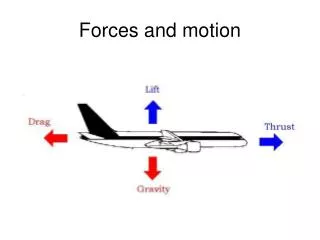
What is Force? • Force is a push or pull that one object exerts on another • Force can cause the motion of a object to change.
Balanced Forces • Force does not always change velocity, two or more equal forces acting on an object in opposite directions can cancel each other out. The net force is zero.
Unbalanced Forces • Unequal forces applied in opposite directions lead to a net force in the direction of the larger force and movement in that direction
Friction • The force that opposes the sliding motion of two surfaces that are in contact
What Causes Friction? • Frictional force depends on the materials that the surfaces are made of and the roughness of the two surfaces • All surfaces have bumps and dips in them that can cause contact and thereby friction (microwelds)
Frictional Force • FF increases when the force pushing the surfaces together increases.
Static Friction • The frictional force that prevents two surfaces in contact from sliding past each other. Once the applied force is greater, the object will move.
Rolling Friction • Rolling friction is usually much less that static friction, that is why we use wheels!
Air Resistance • This force opposes the motion of objects that move through the air. • Air resistance acts in the opposite direction of the objects movement • The greater the surface area of the object the greater the power of air resistance on that object
Terminal Velocity • As an object falls it accelerates due to gravity, however air resistance eventually steps in to slow the object to a speed that no longer increases…that equaled out speed is called terminal velocity!