Understanding Design Patterns: The Decorator and Strategy Patterns Explained
This guide delves into two important design patterns in software development: the Decorator and Strategy Patterns. The Decorator pattern allows you to dynamically attach additional responsibilities to objects without altering their structure, making it easier to extend functionalities like filtering input text or modifying behavior. The Strategy pattern offers a way to define interchangeable algorithms so that the method of processing can be changed without modifying the codebase, promoting flexibility and reusability. Learn how these patterns enhance code organization and adaptability.

Understanding Design Patterns: The Decorator and Strategy Patterns Explained
E N D
Presentation Transcript
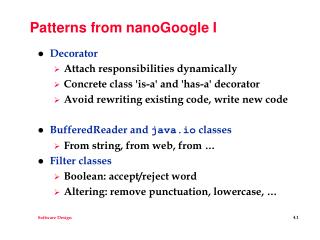
Patterns from nanoGoogle I • Decorator • Attach responsibilities dynamically • Concrete class 'is-a' and 'has-a' decorator • Avoid rewriting existing code, write new code • BufferedReader and java.io classes • From string, from web, from … • Filter classes • Boolean: accept/reject word • Altering: remove punctuation, lowercase, …
Decorator Details • Name: also-knowns-as Wrapper • Wrap existing object with more responsibilities • HFDP: tall, decaf, skim, latte • Forces: • Add responsibilities to objects without affecting other objects (and remove the responsibilities) • Extension by subclass impractical: class explosion or no access to parent class for subclassing
Patterns from nanoGoogle II • Strategy • Change algorithm, policy without altering existing code, but by writing new code • Program to interface, not implementation • Algorithm varies independently from client • What to do when processing words • Count them, store them, dump them to disk • How to print results after processing words • XML, to file, standard output, …
Strategy Details • Name: also known as Policy • Make algorithms/policies interchangeable • HFDP: how to quack, how to fly • Forces: • Re-use policies between contexts or change them at runtime • Context has-a policy, uses it, can change policy • Don't hardwire policy behavior into client