Understanding Microorganisms: Their Nature, Impact, and Infection Control Strategies
150 likes | 305 Vues
Explore the fascinating world of microorganisms, from the beneficial ones that decompose organic material to the harmful pathogens that cause diseases like E. coli and Salmonella. This overview discusses how microorganisms thrive based on conditions such as food, moisture, temperature, oxygen, and light. Learn about their transmission methods and the body's reactions to infections. Understand the significance of infection control in healthcare settings, emphasizing the responsibility of health workers to implement proper techniques to prevent the spread of infections.


Understanding Microorganisms: Their Nature, Impact, and Infection Control Strategies
E N D
Presentation Transcript
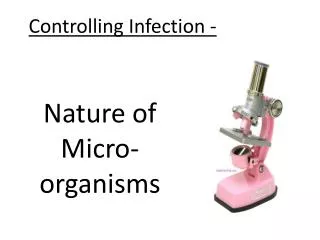
Controlling Infection - Nature of Micro-organisms
Microorganisms • What are they? • Tiny organisms found in the air, on our skin, in our food, and on everything we touch that you cannot see without a microscope • Good • Nonpathogenic, keep a balance in our environment • Bad • Pathogenic, cause illness, infection, or disease
Microorganisms • Anaerobic • Able to grow and function without oxygen • Aerobic • Require oxygen to survive
Microorganisms • Most that cause illness like warm temperatures (like the body temp) • All need moisture • Most prefer a dark area to grow What organisms in biology class like the same things?? Mold and Fungus
Microorganisms • Nonpathogenic Organisms • Used for good things like making foods and beverages • Decompose organic material in nature • Breakdown food elements in the digestive system • Help control the growth of pathogenic organisms
Microorganisms • Pathogenic Organisms • When organisms leave their normal environment in the body and move into other areas and become harmful • Examples: • E.coli • Salmonella • Bacteria – Staph • Viruses
Microorganisms • Conditions Affecting the Growth of Bacteria 1. Food – bacteria grow well in the food left in a patient’s room 2. Moisture – bacteria grow well in moist places
Microorganisms • Conditions Affecting the Growth of Bacteria 3. Temp • 170 degrees F - kills most bacteria • 50-110 degrees F - most disease causing bacteria grow rapidly • 98.6 degrees F – normal human body temp where bacteria can thrive easily • 32 degrees F – low temperatures slow their activity and growth rate
Microorganisms • Conditions Affecting the Growth of Bacteria 4. Oxygen - Aerobic – need oxygen - Anaerobic - don’t need oxygen 5. Light - Darkness – bacteria become active and multiply - Light – when exposed to direct sunlight bacteria become sluggish and die rapidly 6. Dead and Living Matter - Saprophytes – bacteria that live on dead matter or tissues - Parasites – bacteria that live on living matter
Microorganisms • How they affect the body • Produce toxins • Food poisoning causes fatigue, diarrhea, and vomiting • Tetanus toxins cause damage to the nervous system • Histamines cause allergic reactions like runny noses or more severe such as anaphylactic shock
Microorganisms • How they are spread • Direct contact • Indirect Contact • Airborne • Oral Route • Insects and Pests
Microorganisms • How do we protect from them? • Standard Precautions and Transmission-Based Precautions • Will cover later
Microorganisms • Signs and Symptoms of an Infection • Generalized (example: cold and flu) • Headache, fatigue, fever, increased pulse and respiration • Localized (staph infection) • Redness, swelling, heat, possible drainage, pain
Microorganisms • So what is the point??? • Microorganisms are all around us. • Some are good and some are bad • We need to understand them and how they spread to protect ourselves and our patients • Learn how to control and treat them • As a healthcare worker it is your responsibility to practice good techniques to prevent the spread of infection