Tuberculosis
Tuberculosis (TB) is a severe bacterial infection that spreads through lymph nodes and the bloodstream, affecting various organs in the body. In 2012, there were 9,945 reported cases, resulting in 1.3 million deaths globally. TB weakens the lungs and the immune system, leading to dire health consequences if untreated. Treatment involves a long course of antibiotics lasting 6-9 months. Notably, studies show an increase in TB-related deaths among older adults. World Tuberculosis Day highlights the need for awareness and ongoing management of this persistent disease.

Tuberculosis
E N D
Presentation Transcript
Tuberculosis By: Ashlyn, Sarah, Zeven, Logan
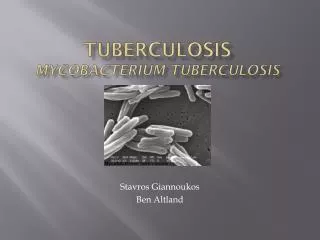
What is it? • It is commonly know as Tb. • It is a bacterial infection that can spread though the lymph nodes and the bloodstream. • It can go to any organ in your body.
Last major occurrence • It was in 2012 • There were a total of 9,945 cases. • There were 1.3 million deaths world wide
What does it do? • It weakens the lungs. • It also weakens the immunesystem.
What has been done about it • Without treatment TB can be fatal • Untreated active diseases typically effect the lungs, but can spread. • Medications are cornerstone of TB treatment. • Antibiotics should be taken for at least 6-9 months
Why is this relevant to us today? • In postmortem investigations on 65,002 unselected adults from 1961-1985 2,633(4.1%) causes of TB among them 1,471(23%) inactivated and 1,162(1.9%) active forms. • The average age of deaths of TB increased a lot(71-80 years old).
Sources • www.webmal.com/lung/understanding-tuberculesis-basics • www.mayoclinic.org/diseases-conditions/tuberculosis/basics/complications/con-20021761 • www.ncvi.nlm.nih.gov/pubmed/3245350 • http://www.ktsm.com/official-tuberculosis-an-issue-in-el-paso • http://the-newest-gadget.blogspot.com/2011/05/mic-gadget_25.html • www.cdc.gov/tb/publications/sactsheets/statistcs/TBTrends.htm