
Advances in RNA Precursor Processing and Self-Splicing Mechanisms
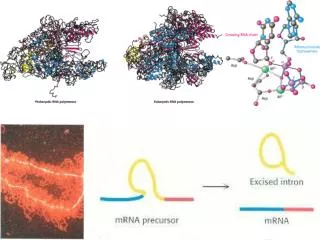
The maturation of yeast tRNA precursors involves the intricate removal of introns, cleavage of 5′ leaders, and 3′ end modifications, including CCA addition. Significant contributions to our understanding of RNA processing were made by Dr. Richard Roberts and Dr. Phillip Sharp, whose work on split genes and RNA splicing revolutionized genetic science and offered insights into gene evolution in higher organisms. Notably, Tetrahymena's ribosomal RNA precursor showcases self-splicing capabilities, exemplifying how RNA can catalyze its own processing without protein involvement.

Advances in RNA Precursor Processing and Self-Splicing Mechanisms
E N D
Presentation Transcript
σ σ70, σ32, σ54
Sp1 HSTF
Transfer RNA Precursor Processing. The conversion of a yeast tRNA precursor into a mature tRNA requires the removal of a 14-nucleotide intron (yellow), the cleavage of a 5′ leader (green), and the removal of UU and the attachment of CCA at the 3′ end (red). In addition, several bases are modified.
Dr. Richard Roberts and Dr. Phillip Sharp, Your discovery of split genes led to the prediction of a new genetic process, that of RNA splicing. The discovery also changed our view of how genes in higher organisms develop during evolution. On behalf of the Nobel Assembly of the Karolinska Institute I wish to convey to you our warmest congratulations, and I now ask you to step forward to receive the Nobel Prize from the hands of His Majesty the King.
Self-Splicing. A ribosomal RNA precursor from Tetrahymena splices itself in the presence of a guanosine co- factor (G, shown in green). A 414-nucleotide intron (red) is released in the first splicing reaction. This intron then splices itself twice again to produce a linear RNA that has lost a total of 19 nucleotides. This L19 RNA is catalytically active