Understanding Hess's Law: Calculating Enthalpy of Chemical Reactions
Hess's Law states that the total enthalpy change for a reaction can be calculated by summing the enthalpy changes of individual steps, similar to algebraic equations. This principle allows for the determination of heat released or absorbed in reactions that are difficult to measure directly. For instance, the formation of rust (Fe2O3) from iron (Fe) and oxygen (O2) can be calculated using related equations. By rearranging given reactions, we can derive the overall enthalpy change, facilitating a better understanding of energy changes in chemical processes.

Understanding Hess's Law: Calculating Enthalpy of Chemical Reactions
E N D
Presentation Transcript
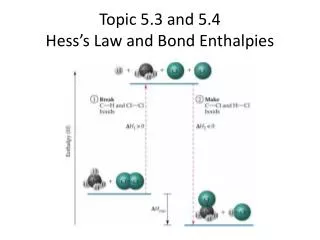
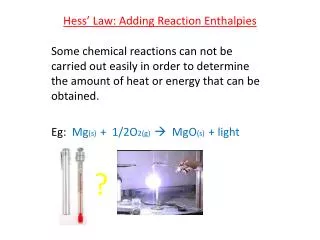
Hess’ Law: Adding Reaction Enthalpies Some chemical reactions can not be carried out easily in order to determine the amount of heat or energy that can be obtained. Eg: Mg(s) + 1/2O2(g) MgO(s) + light ?
G.H. Hess recognized a relationship between algebra and chemical equations. Chemical reactions can be added, subtracted, multiplied, and divided like math equations. For any chemical reaction that can be written in a series of steps, the overall enthalpy of the reaction is the result of adding up the sum of all the individual steps of the reaction.
Eg: Calculate the enthalpy of reaction for the formation of rust. 2Fe(s) + 3/2O2(g) Fe2O3(s) Given: • Fe2O3(s) + 3CO(g) 2Fe(s) + 3CO2(g) DHo= -26.7 kJ • CO(g) + 1/2O2(g) CO2(g)DHo= -282.7 kJ We can rearrange the given equations in a manner that will yield the overall reaction.
X-1 2Fe(s) + 3CO2(g) Fe2O3(s) + 3CO(g) DHo= +26.7kJ • X3 3CO(g) + 3/2O2(g) 3CO2(g) DHo=-848.1kJ _____________________________________________ 2Fe(s) + 3/2O2(g) Fe2O3(s) DHo=-821.4kJ