Beryllium: Properties and Applications
160 likes | 300 Vues
This document explores the use of beryllium in opto-mechanical engineering, emphasizing its exceptional properties such as high specific stiffness, lightweight, and dimensional stability across various temperatures. It details manufacturing processes including traditional die pressing, hot isostatic pressing, and vacuum hot pressing, noting their advantages and challenges. Applications highlighted include cryo telescopes like the Spitzer and James Webb Space Telescopes and beam pipes in the Large Hadron Collider, showcasing beryllium's significance in advanced engineering.


Beryllium: Properties and Applications
E N D
Presentation Transcript
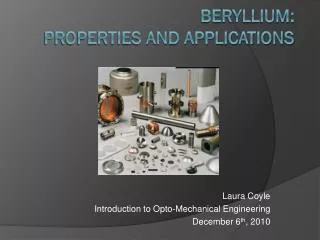
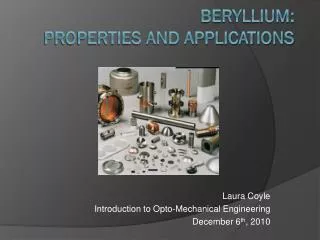
Laura Coyle Introduction to Opto-Mechanical Engineering December 6th, 2010 Beryllium:Properties and Applications
Outline • Why use Beryllium? • Important Properties • Manufacturing Process • Applications
Why Beryllium? STIFF, yet LIGHTWEIGHT DIMENSIONALLY STABLE OVER A WIDE RANGE OF TEMPERATURES
More Properties • Resistant to corrosion • High specific stiffness (E/density ~ 160) • Compare to Aluminum (26), Titanium (25) • Similar to Silicon Carbide (140) • High X-ray transparency • Not magnetic • Toxic to humans
Traditional Die Pressing • Load powder into a mold • Compress using a punch (uniaxial) • Issues: • Non-uniform compaction • Geometrical limitations • Cannot achieve 100% theoretical density
Hot Isostatic Pressing • Load powder into a copper mold • Enclose in steel can • Outgas (remove particles that can interfere with bonding) • Compress powder hydrostatically using hot gas • Leach in nitric acid to dissolve mold • Remove mirror
Vacuum Hot Pressing • Power in mold is compressed from two opposing directions at 1000°C • Compare to HIP • HIP can have up to 50% higher microyield strength • Lower cost • Less lead time • Larger blanks – often used to bond HIP’ed pieces together
Powder • HIP is used so make the blank as isotropic as possible • Powder geometry can help: • Can better predict shape of final blank made with spherical powder– less machining required • Spherical powder increases blank isotropy – can use die pressing, vacuum hot pressing
Polishing • Blanks are cast with near-net shape; usually little machining is required • Polishing can typically achieve surface roughessness of 20 angstroms, and surface flatness of λ/20 peak-valley • Beryllium oxide forms on surface • No coating needed in IR • Coating for visible/UV is often gold, silver, aluminum
Cost • Depends on size, complexity, surface finish • Beryllium is an expensive material – powder type can change cost by 50% • Can mix with aluminum to reduce cost • Better to use HIP than machine from scratch • Tolerances on surface can be the driving factor • 20 angstroms RMS is fairly standard • 10 angstroms RMS is possible with increased cost • Coatings add to cost as well • Quote from AXSYS for 25 mm bare optic • Beryllium (30 angstroms RMS) - $1334 • Aluminum (50 angstroms RMS) - $646
Application: Cryo Telescopes • Good dimensional stability at low temperatures • Lightweight • Used in Spitzer Space Telescope, James Webb Space Telescope
Application: Supercolliders • Beryllium is used to make the beam pipes in all 4 experiments for the Large Hadron Collider • Dimensionally stable at low temperatures, high vacuum • Non-magnetic – does not interfere with magnets used to steer/focus particle beams • Transparent to high energy particles – does not become radioactive
References • “Beryllium Products.” Brush Wellman, Inc. <http://www.berylliumproducts.com/> • Delatte, Michelle, L., “Ultralight weight Beryllium mirror development,” Proc. SPIE, Vol. 1753 (1993). • Marder, James, “Creation of aspheric beryllium optical surfaces directly in the hot isostatic pressing consolidation process,” Proc. SPIE Vol. 1485 (1991). • Parsonage, Thomas. “JWST Beryllium Telescope: Material and Substrate Fabrication,” Proc. SPIE, Vol. 5494, 39 (2004). • Vudler, V., Richard, P., “Beryllium Mirrors: Refinements Enable New Applications,” The Photonics Design and Applications Handbook (2002) <http://www.hardric.com> • Yoder, Paul R., Opto-Mechanical Systems Design, 3rd edition. SPIE Press: Washington, D.C. (2006). pp. 118-121.