Download
1 / 10
200 likes | 597 Vues
This presentation by Sanarmohamed explores the fundamental differences between written and spoken discourse analysis, illustrating various classifications such as grammatical intricacy, lexical density, nominalization, and explicitness. While written discourse is typically more structured and explicit, spoken discourse exhibits characteristics like spontaneity, repetition, and informal vocabulary. Understanding these differences is vital for researchers and practitioners in linguistics and communication studies, as it impacts interpretation and communication strategies in various contexts.

E N D
Differences between written and spoken discourse analysis Presented By Sanarmohamed
Discourse analysis: is the study of language in its written and spoken form
There are many ways to classify discourse analysis : • Written-spoken • According to register • According to gemre • Monologic
Spoken discourse analysis: on going situated interpretation of speakers communicative intention of which the addressee’s expected and actual reactions are an integral part Written discourse analysis: is a growing field of study it allows researchers to follow different lines of investigation
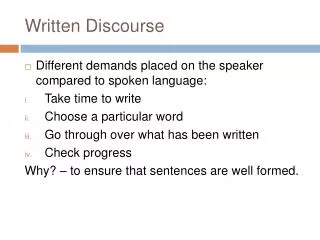
Differences between spoken and written discourse analysis • Grammatical intricacy and structure • Lexical density • Nominalization • Explicitness • Contextualization • Spontaneity • Repetition, hesitation and redundancy • Vocabulary
Grammatical intricacy and structure Written discourse is more structurally and more elaborate then spoken discourse. Lexical density lexical density in spoken discourse is less than written discourse
Nominalization written discourse tends to have longer noun groups than spoken discourseExplicitness written discourse analysis is more explicit than spoken discourse analysis but it is not absolute
Contextualization written discourse analysis is more decontextualized than spokenSpontaneity written discourse analysis is more organized than spoken one
Repetition, hesitation and redundancy spoken discourse contain more repetition , hesitation and redundancy than written one Vocabulary spoken discourse using slang and more simple words written discourse slang avoided and using formal words