Pediatric Vesicoureteral Reflux
100 likes | 101 Vues
All about Pediatric Vesicoureteral Reflux.<br>Description, Diagnosis, treatment.....


Pediatric Vesicoureteral Reflux
E N D
Presentation Transcript
Vesicoureteral reflux (VUR) Prepared by Dr: Monzer
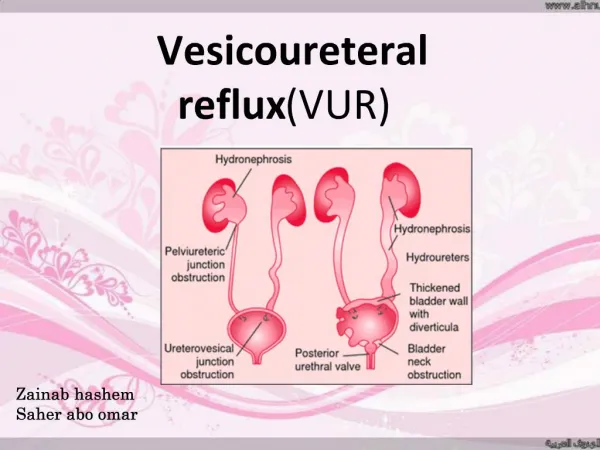
Definition • Vesicoureteral reflux (VUR) describes the retrograde flow of urine from the bladder to the ureter and kidney.
Normal Position • The ureteral attachment to the bladder normally is oblique, between the bladder mucosa anddetrusor muscle, creating a flap-valve mechanism that prevents VUR.
Abnormal Position • VUR occurs when the submucosal tunnel between the mucosa and detrusor muscle is short or absent.
Incidence • Affecting 1-2% of children, VUR usually is congenital and often is familial. • VUR is present in approximately 30% of females who had a urinary tract infection and in 5-15% of infants with antenatal hydronephrosis.
Complications • VUR predisposes to kidney infection (pyelonephritis). • The inflammatory reaction caused by pyelonephritis can result in renal injury or scarring, also termed reflux-related renal injury or reflux nephropathy. • Extensive renal scarring impairs renal function and can result in renin-mediated hypertension. • renal insufficiency or end-stage renal disease. • impaired somatic growth, and morbidity during pregnancy. • In children with a febrile urinary tract infection (UTI), those with VUR are 3 times more likely to develop renal injury compared to those without VUR. • Scarring associated with reflux may be present at birth or develop in the absence of infection. In the past, reflux nephropathy accounted for as much as 15-20% of end-stage renal disease in children and young adults.
Reflux nephropathy remains a common cause of hypertension in children. • VUR in the absence of infection or elevated bladder pressure (e.g., neuropathic bladder, posterior urethral valves) rarely causes renal injury.
Classification of Vesicoureteral Reflux(severity) • VUR severity is graded using the International Reflux Study Classification of I-V and is based on the appearance of the urinary tract on a contrast voiding cystourethrogram (VCUG)