Leveraging Preferential Path Profiling for Efficient Acyclic Graph Analysis
This work introduces a framework for Preferential Path Profiling aimed at optimizing the analysis of intra-procedural acyclic paths within a control flow graph (CFG). The technique employs a unique edge-weighting scheme to generate compact, unique identifiers for paths, facilitating efficient data storage and retrieval. The significant challenge lies in managing the potentially vast number of paths generated by even simple functions while ensuring the robustness against performance issues. We explore the implications for security and bug detection, and propose methods to scale the profiling technique effectively.

Leveraging Preferential Path Profiling for Efficient Acyclic Graph Analysis
E N D
Presentation Transcript
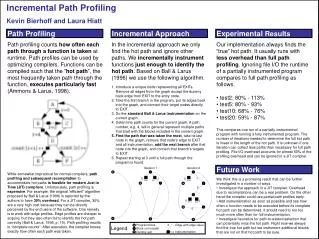
Preferential Path Profiling: Compactly numbering interesting Paths
Bell Larus Profiling • Profiles Intra Procedural, Acyclic Paths • DAGG from the CFG • Idea: Assign weights to the edges of G s.t. the pathIds (which are the sums of the wts of the edges in the path), are Unique. • Given N paths, 0<= pathId(p) <=N-1 pathId| < N • p is the set of paths in G, paths(G). • A path in G is from S to T. • Hence, N also denotes the number of ways of reaching t.
Numbering Ns = Na + Nb + Nc = X+Y+Z S 0 X+Y X Na = X A B C Nb = Y Nc = Z X-1 Y-1 0 Z-1 0 …… 0 …… …… .... .... .... .... .... .... T
Example Ns = Na + Nb = 6 0 4 Na = Nb +Nc =4 2 Nb = Nc = 2 0 0 Nc = Nd + Nt = 2 0 1 0 Nt = 1 Nd = Nt = 1
The Obvious Issue • Expect LARGE number of paths even in an average function. • Size of the Data Structure will have to super huge for sophisticated functions/procedures. • Arrays fail. • Resort to Hash Tables.
Interesting Paths • Sensitive to security • Likely candidates for bugs • Suffering from performance issues • Ideal case: array of size I, i.e. 0 to I-1
Preferential Path Profiling • Numbering:: • UNIQUENESS • COMPACTNESS • Separation Perfect Assignment Compactness • Generalization of the Bell Larus Profiling (??)
Uniqueness • Critical Nodes and paths P and P’ • P and P’:: different pids (partial identifiers) [Lemma4] • (Individual pids) v/s (Intervals of pids) • Interval (edge, prefix): [minPid, maxPid]
V Nv = X+Y 0 X [Lemma 5] Na = X A B Nb = Y X-1 Y-1 0 0 …… …… V Nv = X+Y .... .... .... .... 0 X -1 T Na = X A B Nb = Y int(va,v) = [0,X-1] int(vb,v) = [X,X+Y-1] X-1 Y-1 0 0 …… …… .... .... .... .... T int(va,v) = [0,X-1] int(vb,v) = [X-1,X+Y-2]
Compactness V X 0 cumulative interval size cis Na = X A B Nb = Y X-1 Y-1 0 0 …… i = 1,2 W(e1) = cis(0) – min(1) = 0 -0 = 0 W(e2) = cis(1) – min(2) = (X-1 – 0 +1) – 0 = X …… .... .... .... .... T cis uniqueness min(i) compactness int(va,v) = [0,X-1] int(vb,v) = [0,Y-1] int(va,v) = [0,X-1] int(vb,v) = [X-1,X+Y-1]
V 0 X+Y X All the paths are interesting here. Na = X A B C Nb = Y Nc = Z X-1 Y-1 0 Z-1 0 …… 0 …… …… .... .... .... .... .... .... T int(va,v) = [0,X-1] int(vb,v) = [0,Y-1] int(vc,v) = [0,Z-1] int(va,v) = [0,X-1] int(vb,v) = [X,X+Y-1] int(vc,v) = [0,Z-1] int(vb,v) = [X,X+Y-1] int(va,v) = [0,X-1] int(vc,v) = [X+Y, X+Y+Z-1]
Algorithm join
Questions for Discussion • How do you think cyclic graphs will limit this approach? • Can you apply the same/similar technique for an inter-procedural profiling of paths?