Enhancing Network Security at University of Washington: Strategies and Infrastructure Overview
This document outlines the University of Washington's extensive network security framework as of October 2003. It covers the UW campus network infrastructure, including its backbone, border routers, and level one routers, supporting over 60,000 live devices across diverse subnets. It also introduces the Pacific Northwest Gigapop, a crucial access point for high-performance internet connectivity, including Internet2. The text discusses vital security axioms and defense strategies that highlight the importance of a layered security approach, the role of firewalls, and proactive monitoring tools for optimizing network security.

Enhancing Network Security at University of Washington: Strategies and Infrastructure Overview
E N D
Presentation Transcript
uw network security2003 Terry Gray University of Washington Computing & Communications 17 October 2003
UW campus network (backbone) border router border router backbone switches ~ 30 level one routers subnets (733 total; 150 c&c); over 60,000 live devices
UW campus network (typical subnet) Level One Router • campus subnets are a mixture of • shared 10Mbps • switched 10Mbps • switched 10/100Mbps Aggregation Switch Edge Switch Edge Switch Edge Switch
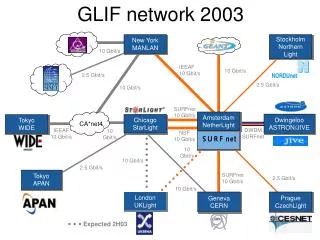
Pacific Northwest Gigapop • The PNW’s access point to next generation Internets, including Internet2, high performance USA Federal Networks, and high speed commodity Internet • A high speed peering point for regional and international networks • R&D testbed inviting national and international experimentation with advanced Internet-based applications
Pacific Northwest Gigapop national & internat’nl nets Internet2 3 diverse network providers • Internet2 2.5Gbps • (10Gbps upgrade underway) • Three different 1Gbps • connections to the Internet • Multiple gigabits of connections • to other networks 30+ network customers uw border uw border
K20 Network Sites Public Baccalaureate (50) Community/Technical College (73) K-12 (307) Library (65 in process) Independent Colleges (9 approved)
seven security axioms • Network security is maximized when we assume there is no such thing. • Large security perimeters mean large vulnerability zones. • Firewalls are such a good idea, every computer should have one. Seriously. • Remote access is fraught with peril, just like local access. • One person's security perimeter is another's broken network. • Isolation strategies are limited by how many PCs you want on your desk. • Network security is about psychology as much as technology. Bonus: never forget that computer ownership is not for the feint-hearted.
credo • focus first on the edge(perimeter protection paradox) • add defense in depth as needed • keep it manageable • provide for local policy choice... • avoid one-size-fits-all
gray’s defense-in-depth conjecture • MTTE (exploit) = k * N**2 • MTTI (innovation) = k * N**2 • MTTR (repair) = k * N**2where N = number of layers
C&C security activities • logical firewalls • project 172 • network infrastructure protection • reverse IDS (local infection detection) • auto-block; self-reenable • traffic monitoring tools • who/where traceability tools • nebula • proactive probing • honeypots • security operations • training; consulting