Advancements in Directed Multiscale Assembly of Cellular Metamaterials for Tissue Engineering
This project at the University of Michigan, led by Stephen Forrest and Clarence Chan, explores the application of semiconductor industry technologies for tissue engineering via directed multiscale assembly of cellular metamaterials. Key techniques such as Thermal Evaporation and Organic Vapor Jet Printing (OVJP) are investigated to enhance material utilization and precision in nanoscale fabrication. The research aims to improve interfaces between cells and surfaces by generating focal adhesion sites, thereby creating scalable processes applicable to tissue engineering.

Advancements in Directed Multiscale Assembly of Cellular Metamaterials for Tissue Engineering
E N D
Presentation Transcript
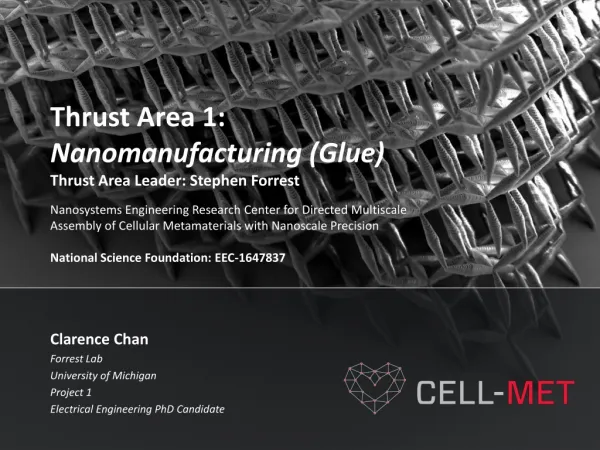
Thrust Area 1:Nanomanufacturing (Glue) Thrust Area Leader: Stephen Forrest Clarence Chan Forrest Lab University of Michigan Project 1 Electrical Engineering PhD Candidate Nanosystems Engineering Research Center for Directed Multiscale Assembly of Cellular Metamaterials with Nanoscale Precision National Science Foundation: EEC-1647837
Overview • Clarence Chan is an Electrical Engineering PhD student and a member of the Optoelectronic Components and Materials group at the University of Michigan. His work would be applied to TA1 of the CELL-MET ERC. • Question: Can we translate the technologies and materials developed by the semiconductor industry for applications in scaling and parallel processing for tissue engineering purposes? • Contents of talk: • Introduction • Technology and Challenges • Applications and Expectations Nanosystems Engineering Research Center for Directed Multiscale Assembly of Cellular Metamaterials with Nanoscale Precision: CELL-MET National Science Foundation: EEC-1647837
Introduction: Thermal Evaporation • Vacuum Thermal Evaporation (VTE) • Physical vapor deposition technique • Operates under high vacuum (10-7 torr) • Evaporation from resistive heating • Issues • Material coats everything • Material utilization is low Source Mask – Metal or Si Substrate Angstrom VTE system from the OCM deposition lab Nanosystems Engineering Research Center for Directed Multiscale Assembly of Cellular Metamaterials with Nanoscale Precision: CELL-MET National Science Foundation: EEC-1647837
Introduction: Organic Vapor Jet Printing • Organic Vapor Jet Printing (OVJP) • Physical vapor deposition utilizing inert carrier gas • Operates under vacuum (10-4 torr) • Evaporation from resistive heating (higher temperature) • Improvements • Directional write patterning • High material utilization Image courtesy: Gregory J. McGraw Figure from Shteinet al, Advanced Materials, 2004 Nanosystems Engineering Research Center for Directed Multiscale Assembly of Cellular Metamaterials with Nanoscale Precision: CELL-MET National Science Foundation: EEC-1647837
Technology • OVJP is used for direct writing organic material • The most fundamental application is in display technology • OLEDs used in displays for phones and TVs can be produced this way • The resolution required for high pixel density is enabled via micro-nozzles • Ideal for parallel and scaled production Image courtesy: Gregory J. McGraw Nanosystems Engineering Research Center for Directed Multiscale Assembly of Cellular Metamaterials with Nanoscale Precision: CELL-MET National Science Foundation: EEC-1647837
Challenges • The key challenges for OVJP are: • Line of sight (LOS) • High temperature deposition • Resolution is limited to micron scale • Nozzle/Substrate registration • Vacuum process • Key problem to solve: • How to integrate this scalable direct write technology with other ERC processing techniques such as Atomic Calligraphy and Nanoscribe Nozzle Source Source + gas flow H Mask – Metal or Si Substrate Substrate Nanosystems Engineering Research Center for Directed Multiscale Assembly of Cellular Metamaterials with Nanoscale Precision: CELL-MET National Science Foundation: EEC-1647837
Three-Plane Diagram Nanosystems Engineering Research Center for Directed Multiscale Assembly of Cellular Metamaterials with Nanoscale Precision: CELL-MET National Science Foundation: EEC-1647837
Application • OVJP allows writing of patterned organic small molecules on surface • Organic small molecules can be used as a negative for anti-cell adhesion coatings • Cells can interface with the surface via protein which can selectively adsorb against organic negative patterns Image courtesy: Gregory J. McGraw OCM Group Logo Figure from Chen et al, Science, 1997 Nanosystems Engineering Research Center for Directed Multiscale Assembly of Cellular Metamaterials with Nanoscale Precision: CELL-MET National Science Foundation: EEC-1647837
Expectations • Generating focal adhesion sites for cells allows: • Mechanistic studies of cell to environment interfacing • Insight on how to engineer suitable tissue models • Fundamental processing should be scalable and can integrate into a roll-to-roll (R2R) process • Samples can then be produced with high throughput to accelerate testing (i.e. assays) OCM Lab R2R System. Image courtesy: Angstrom Engineering Figure from Qu et al, Applied Physics Letters, 2018. Nanosystems Engineering Research Center for Directed Multiscale Assembly of Cellular Metamaterials with Nanoscale Precision: CELL-MET National Science Foundation: EEC-1647837
Nanosystems Engineering Research Center for Directed Multiscale Assembly of Cellular Metamaterials with Nanoscale Precision National Science Foundation: EEC-1647837