Understanding Addition and Subtraction of Rational Expressions
60 likes | 200 Vues
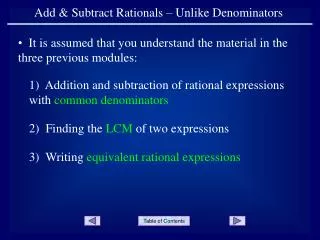
In this lesson, students will gain a comprehensive understanding of how to add and subtract rational expressions. By recalling previous knowledge, students will learn the importance of having a common denominator to successfully perform these operations. We'll explore how these processes differ from multiplication and division, focus on evaluating functions using functional notation, and emphasize the significance of identifying undefined values (when the denominator equals zero). Assignments will reinforce these concepts through practice problems.


Understanding Addition and Subtraction of Rational Expressions
E N D
Presentation Transcript
8.3 Add/Subtract Rational Expressions 9.2.1.1 Understand the definition of a function. Use functional notation and evaluate a function at a given point in its domain.
Guiding Question: How is adding/subtracting different than mult/div? • Lesson Obj:IWBAT add/subtract rational expressions Recall how to do the following….
Guiding Question: How is adding/subtracting different than mult/div? • To add/subtract the fractions must have a common denominator. • If it does not, you must create one. • Don’t forget to state where the function is undefined (denominator = 0)
Guiding Question: How is adding/subtracting different than mult/div? Create a common denominator here… How will these look? 3. 4.
Guiding Question: How is adding/subtracting different than mult/div? • Assignment: Pg. 588 2-4, 7-15 • Day 2: 22, 25, 27, 32, 42a-b