Download
1 / 12
120 likes | 236 Vues
This study examines the bioaccumulation of Decamethylcyclopentasiloxane (D5) in marine ecosystems, highlighting its persistence and potential effects on aquatic life. Despite being non-toxic to humans, D5 is widely used in personal care products, raising concerns about environmental impact. Using Gas Chromatography-Mass Spectrometry (GC-MS), we analyze sediment and fish samples to measure D5 levels and explore regulations for silicone use in cosmetics. This research aims to inform stakeholders on sustainable practices and the ecological ramifications of silicone compounds.

E N D
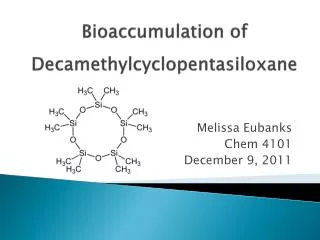
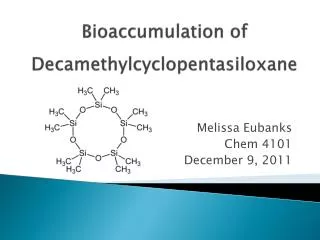
Bioaccumulation of Decamethylcyclopentasiloxane Melissa Eubanks Chem 4101 December 9, 2011
The Problem • Silicones are widely used in the personal care and cosmetics industry • Persistence in environment • Decamethylcyclopentasiloxane (D5) is not toxic to humans but may build up in the marine environment
Importance of Solving the Problem: • Many companies worry about going silicone free • Influence product performance and cost • Regulate the use of silicones in personal care products • Stop possible effects on environment • Hypothesis: • Decamethylcyclopentasiloxane (D5) is being washed from skin and hair and bioaccumulating in aquatic life.
GC/MS 2
Gas Chromatography • Decamethylcyclopentasiloxane • Mass: 370.77g/mol • BP: 210°C • Volatile compound • Requires small samples • Separating complex mixtures • Very high precision • Sensitive to detect volatile organic mixtures of low concentrations
Mass Spectrometry • Quadrupole MS Analyzer • Fast scan rate • Inexpensive • Easily interfaced to • other Ionization • Methods • Electron Ionization 5
Description of Instrument • Gas Chromatography coupled with Mass Spectrometry • Trace GC Ultra • MD800 MS detector • Electron Ionization • Splitless injector with microseal septum • 5µL sample injection • Injector temperature of 220°C • Carrier Gas: Helium
Experimental Design • Preparing Sediment for Analysis as raw extract3: • Top layer undisturbed sediment collected • Extraction by Sedimentation • Centrifugation • Liquid phase separated from solid • Extraction and centrifuge repeated with remaining solid phase • Liquid phases combined • Wash liquid phases • Centrifugation • Liquid phase separated from any remaining large particles
Preparing Fish Samples • Rinse, wrap and seal in bags, freeze at -17°C • Frozen dorsal fillet • Cold solvent extraction • Centrifuge and repeat extraction • 4mL acetone, 2mL n-hexane • Addition on 20mL water and 0.1g sodium chloride • Centrifugation for 10min • Inject sample into GC/MS
Discussion Multimedia Bioaccumulation Factor (mmBAF) • Use of 13C labeled D5 standards • Bioaccumulative in air breathing marine mammals? • Complex bioaccumulation regulations
References 1.) Reisch, M. Storm Over Silicones. C&EN Northeast News Bureau 2011, 89, pp 10-13. 2.) Skoog, D.; Holler, F.; Crouch, S. Principles of Instrumental Analysis, 6th ed., Thomson Brooks/Cole: Belmont, 2007. 3.) Kierkegaard, A.; van Egmond, R.; McLachlan, M. S; Cyclic Volatile Methylsiloxane Bioaccumulation in Flounder and Ragworm in the Humber Estuary. Environmental Science and Technology. 2011, 5936-5942. 4.) Kierkegaard, A.; van Egmond, R.; McLachlan, M. S; Determination of Cyclic Volatile Methylsiloxanes in Biota with a Purge and Trap Method. Anal. Chem. 2010, 82, 9573-9578. 5.) Pickering, G.; Oliff, C.; Rutt, K., The Mass Spectrometric Behavior of Dimethylcyclosiloxanes. Organic Mass Spectrometry. 1975, 10, 1035-1045. 6.)http://www.sigmaaldrich.com/catalog/ProductDetail.do?D7=0&N5=SEARCH_CONCAT_PNO|BRAND_KEY&N4=444278|ALDRICH&N25=0&QS=ON&F=SPEC 7.)http://www.spexcertiprep.com/products/product_organic.aspx?part=S-1110 8.) Almond, M. Becerra, R. Bowes, S. Cannady, J. Ogden, S. Young, N and Walsh R. A Mechanistic Study of the Low Pressure Pyrolysis of Linear Siloxanes. Physical Chemistry Chemical Physics. 2008, 11, 6856-6861