Thermodynamics of abstract composition rules
590 likes | 780 Vues
This work explores non-extensive thermodynamics, focusing on the statistical macro-equilibrium of long-range correlated and entangled systems. It involves generalizations of entropy formulas and the Boltzmann equation, examining applications within various fields such as astrophysics, granular matter, and finance. The talk presented at the Zimányi School in Budapest outlines the framework for understanding complex systems through additive and non-additive composition rules, aiming to bridge the gap between classical and modern statistical mechanics.


Thermodynamics of abstract composition rules
E N D
Presentation Transcript
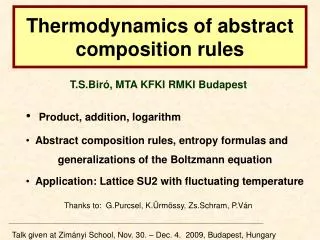
Thermodynamics of abstract composition rules T.S.Biró, MTA KFKI RMKI Budapest Product, addition, logarithm Abstract composition rules, entropy formulas and generalizations of the Boltzmann equation Application: Lattice SU2 with fluctuating temperature Thanks to: G.Purcsel, K.Ürmössy, Zs.Schram, P.Ván Talk given at Zimányi School, Nov. 30. – Dec. 4. 2009, Budapest, Hungary
Non-extensive Thermodynamics The goal is to describe: statistical macro-equilibrium irreversible properties of long-range correlated (entangled) systems
Non-extensive Thermodynamics This is a dream ! The goal is to describe: statistical macro-equilibrium irreversible properties of long-range correlated (entangled) systems
Non-extensive Thermodynamics This is a theory... Generalizations done (more or less): entropy formulas kinetic eq.-s: Boltzmann, Fokker-Planck, Langevin composition rules Most important: fat tail distributions canonically
Applications (fits) • galaxies, galaxy clusters • anomalous diffusion (Lévy flight) • turbulence, granular matter, viscous fingering • solar neutrinos, cosmic rays • plasma, glass, spin-glass • superfluid He, BE-condenstaion • hadron spectra • liquid crystals, microemulsions • finance models • tomography • lingustics, hydrology, cognitive sciences
Logarithm: Product Sum additive extensive
Abstract Composition Rules EPL 84: 56003, 2008
Asymptotic rules are associative and attractors among all rules…
Deformed logarithm Deformed exponential
Entropy formulas, distributions Boltzmann – Gibbs Rényi Tsallis Kaniadakis … EPJ A 40: 325, 2009
Entropy formulas from composition rules Joint probability = marginal prob. * conditional prob. The last line is for a subset
Entropy formulas from composition rules Equiprobability: p = 1 / N Nontrivial composition rule at statistical independence
Entropy formulas from composition rules 1. Thermodynamical limit: deformed log
Boltzmann algorithm: pairwise combination + separation With additive composition rule at independence: Such rules generate exponential distribution
Boltzmann algorithm: pairwise combination + separation With associative composition rule at independence: Such rules generate ‘exponential of the formal logarithm’ distribution
Detailed balance: G = G 12 34
Important example: product class QCD is like this!
Relativistic energy composition ( high-energy limit: mass ≈ 0 )
Physics background: α q > 1 q < 1 Q²
Simulation using non-additive rule PRL 95: 162302, 2005 with Gábor Purcsel • Non-extensive Boltzmann Equation • (NEBE) : • Rényi-Tsallis energy addition rule • random momenta accordingly • pairwise collisions repeated • momentum distribution collected
Stationary energy distributions in NEBE program x + y x + y + 2 x y
Károly Ürmössy Scaling variable E or X(E)?
Károly Ürmössy Scaling variable E or X(E)?
Microscopic theory in non-extensive approach: questions, projects, ... • Ideal gas with deformed exponentials • Boltzmann and Bose distribution • Fermi distribution: ptl – hole effect • Thermal field theory with stohastic temperature • Lattice SU(2) with Gamma * Metropolis method
As if temperature fluctuated… • EulerGamma Boltzmann = Tsallis • EulerGamma Poisson = Negative Binomial
Euler - Gamma distribution max: 1 – 1/c, mean: 1, spread: 1 / √ c
Tsallis lattice EOS Tamás S. Bíró (KFKI RMKI Budapest) and Zsolt Schram (DTP ATOMKI Debrecen) • Lattice action with superstatistics • Ideal gas with power-law tails • Numerical results on EOS
Lattice theory Expectation values of observables: -S(t,U) DU dt w (t) e t A(U) ∫ ∫ v c A = -S(t,U) DU dt w (t) e ∫ ∫ c Action: S(t,U) = a(U) t + b(U) / t t= a / a asymmetry parameter t s
Su2 Yang-Mills eos on the lattice with Euler-Gamma distributed inverse temperature: Effective action method with Zsolt Schram (work in progress) preliminary
Method: EulerGamma * Metropolis • asymmetry thrown from Euler-Gamma • at each Monte Carlo step / only after a while • at each link update / only for the whole lattice • meaning local / global fluctuation in space • c = 1024 for checking usual su2 • c = 5.5 for genuine quark matter