Download
1 / 40
410 likes | 554 Vues
Explore the concept of allylic conjugation in alkadienes and allylic systems, including allylic carbocations, radicals, and their stability. Learn about allylic halogenation and the selective replacement of allylic hydrogen. Discover how resonance models and orbital overlap shape allylic reactions.

E N D
Chapter 10Conjugation in Alkadienes andAllylic Systems • conjugare is a Latin verb meaning "to link or yoke together"
C C C + The Double Bond as a Substituent allylic carbocation
C C C C C C + • The Double Bond as a Substituent allylic carbocation allylic radical
C C C C C C + • C C C C The Double Bond as a Substituent allylic carbocation allylic radical conjugated diene
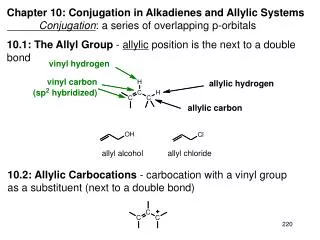
H H C C H H C H 10.1The Allyl Group
Vinylic versus Allylic C C C allylic carbon vinylic carbons
Vinylic versus Allylic H C C H C H vinylic hydrogens are attached to vinylic carbons
H H C C H C Vinylic versus Allylic allylic hydrogens are attached to allylic carbons
Vinylic versus Allylic X C C X C X vinylic substituents are attached to vinylic carbons
Vinylic versus Allylic X X C C X C allylic substituents are attached to allylic carbons
+ C C C 10.2Allylic Carbocations
CH3 Cl H2C C C CH CH3 Allylic Carbocations • the fact that a tertiary allylic halide undergoessolvolysis (SN1) faster than a simple tertiaryalkyl halide CH3 Cl CH3 CH3 123 1 relative rates: (ethanolysis, 45°C)
Allylic Carbocations • provides good evidence for the conclusion thatallylic carbocations are more stable thanother carbocations CH3 CH3 + + H2C C C CH CH3 CH3 CH3 formed faster
CH3 + H2C CH CH3 Allylic Carbocations • provides good evidence for the conclusion thatallylic carbocations are more stable thanother carbocations CH3 + C C CH3 CH3 H2C=CH— stabilizes C+ better than CH3—
Stabilization of Allylic Carbocations • Delocalization of electrons in the doublebond stabilizes the carbocation • resonance modelorbital overlap model
CH3 + + C C H2C H2C CH CH CH3 CH3 Resonance Model CH3
CH3 + + C C H2C H2C CH CH CH3 CH3 Resonance Model CH3 CH3 d+ d+ C H2C CH CH3
Orbital Overlap Model d+ d+
CH3 Cl H2C C CH CH3 CH3 OH H2C C CH CH3 Hydrolysis of an Allylic Halide H2O Na2CO3 CH3 C CH + HOCH2 CH3 (15%) (85%)
CH3 C CH ClCH2 CH3 CH3 CH3 C CH HOCH2 OH H2C C CH CH3 CH3 Corollary Experiment H2O Na2CO3 + (15%) (85%)
CH3 CH3 C CH Cl ClCH2 H2C C CH CH3 CH3 and give the same products because they form the same carbocation
CH3 CH3 C CH Cl ClCH2 H2C C CH CH3 CH3 and give the same products because they form the same carbocation CH3 CH3 + + C C H2C H2C CH CH CH3 CH3
more positive charge on tertiary carbon;therefore more tertiary alcohol in product CH3 CH3 + + C C H2C H2C CH CH CH3 CH3
H2C C CH (85%) (15%) CH3 CH3 + C CH OH HOCH2 CH3 CH3 more positive charge on tertiary carbon;therefore more tertiary alcohol in product CH3 CH3 + + C C H2C H2C CH CH CH3 CH3
• C C C 10.3Allylic Free Radicals
• • C C C C C C Allylic free radicals are stabilized byelectron delocalization
CHCH2 CHCH2—H H2C H2C Free-radical stabilities are related tobond-dissociation energies • C—H bond is weaker in propene because resulting radical (allyl) is more stable than radical (propyl) from propane 410 kJ/mol • + CH3CH2CH2—H CH3CH2CH2 H• • 368 kJ/mol + H•
ClCH2CHCH3 Cl CHCH3 H2C CHCH2Cl H2C Chlorination of Propene addition + Cl2 500 °C + HCl substitution
Allylic Halogenation • selective for replacement of allylic hydrogen • free radical mechanism • allylic radical is intermediate
H H .. . Cl : C C .. H C Hydrogen-atom abstraction step H • allylic C—H bond weaker than vinylic • chlorine atom abstracts allylic H in propagation step H 410 kJ/mol 368 kJ/mol H
.. Cl : : H .. Hydrogen-atom abstraction step H H • C C H H C 410 kJ/mol 368 kJ/mol H
O O NBr NH O O N-Bromosuccinimide • reagent used (instead of Br2) for allylic bromination Br heat + + CCl4 (82-87%)
Limited Scope Allylic halogenation is only used when: • all of the allylic hydrogens are equivalent • andthe resonance forms of allylic radicalare equivalent
H H H H Example Cyclohexene satisfies both requirements All allylichydrogens areequivalent
H H H H H H H H • • H H Example Cyclohexene satisfies both requirements All allylichydrogens areequivalent Both resonance forms are equivalent
CH3CH CHCH3 • • CH3CH CH CH2 CH3CH CH CH2 Example All allylichydrogens areequivalent 2-Butene But Two resonance forms are not equivalent;gives mixture of isomeric allylic bromides.