
Insights from Alkenone Biomarkers: Paleotemperature Records of E. Huxleyi in Marine Sediments
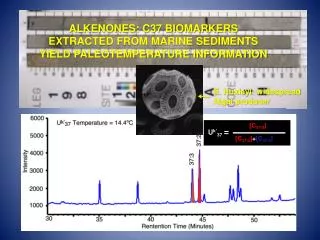
This study explores the extraction of alkenones from marine sediments, specifically focusing on E. huxleyi as a predominant algal producer. These biomarkers provide valuable information on past temperatures, revealing significant paleotemperature transitions approximately 2.5 million and 1.8 million years ago. Notably, the latter transition aligns with the Plio-Pleistocene boundary and presents unique insights not found in other paleoclimate datasets. Understanding these shifts and the preservation of organic biomarkers enhances our knowledge of historical climate changes.

Insights from Alkenone Biomarkers: Paleotemperature Records of E. Huxleyi in Marine Sediments
E N D
Presentation Transcript
[C37:2] Uk’37= [C37:2]+[C37:3] E. huxleyi ALKENONES: C37 BIOMARKERS EXTRACTED FROM MARINE SEDIMENTS YIELD PALEOTEMPERATURE INFORMATION E. Huxleyi: widespread Algal producer
Preservation of organic biomarkers in uplifted marine strata?
Two distinct transitions: ~2.5 Mya and ~1.8 Mya • Increases in the amplitude of SST cycles • The ~1.8 Mya transition (Plio-Pleistocene boundary) not observed in other paleoclimate records
